Manaslu area is a restricted zone. That one factor decides everything you need in terms of Manaslu Circuit Trek permits, checkpoints, and regulations. It is not something that you can buy a ticket and start trekking.
You need a guide; you need to go through a registered trekking company and have many permits checked all along the way. Both Manaslu Circuit and Tsum Valley trekking involve trekking in two different restricted zones and thus require many permits.
Everything needs to be arranged in Kathmandu itself before starting the trip to save any hassle later.
Which Permits Are Required for the Manaslu Region Trek?
Your selection of Manaslu Trek permits will depend upon your trail. For the Manaslu Circuit, you need to buy three major permits. For the Tsum Valley trail, there is one more restricted area permit that you need to buy. For a combination trekking route, you need to buy all of these permits.
A major update from 2026 is that solo trekkers can apply for restricted area permits. There was a rule that there should be a minimum of two trekkers, but it was repealed on 22nd March, 2026.
Manaslu Restricted Area Permit (RAP)
Manaslu Restricted Area Permit (RAP) is the most important permit required for trekking on the Manaslu Circuit route. This permit relates to the restricted area which starts from Jagat and runs through the valley of Budhi Gandaki River.
The Manaslu Restricted Area Permit is provided by the Department of Immigration through the registered trekking agency. This permit is time-bound and seasonal.
Manaslu Conservation Area Permit (MCAP)
The Manaslu Conservation Area Permit is mandatory for all trekkers who are entering the Manaslu Conservation Area. It applies to the lower and mid-level section of the trekking route before the restricted area starts. The MCAP is provided by the National Trust for Nature Conservation. It is a one-time entry permit.
Annapurna Conservation Area Permit (ACAP)
The Annapurna Conservation Area Permit is applicable only when you follow an itinerary that goes through the Annapurna Conservation Area. This would be on a normal Manaslu Circuit trekking route, as it comes into effect once you have crossed the Larkya La Pass. In the last leg of the trekking journey from Dharapani onward, you would go through the Annapurna Conservation Area. The ACAP is verified from Dharapani onwards and other exit points.

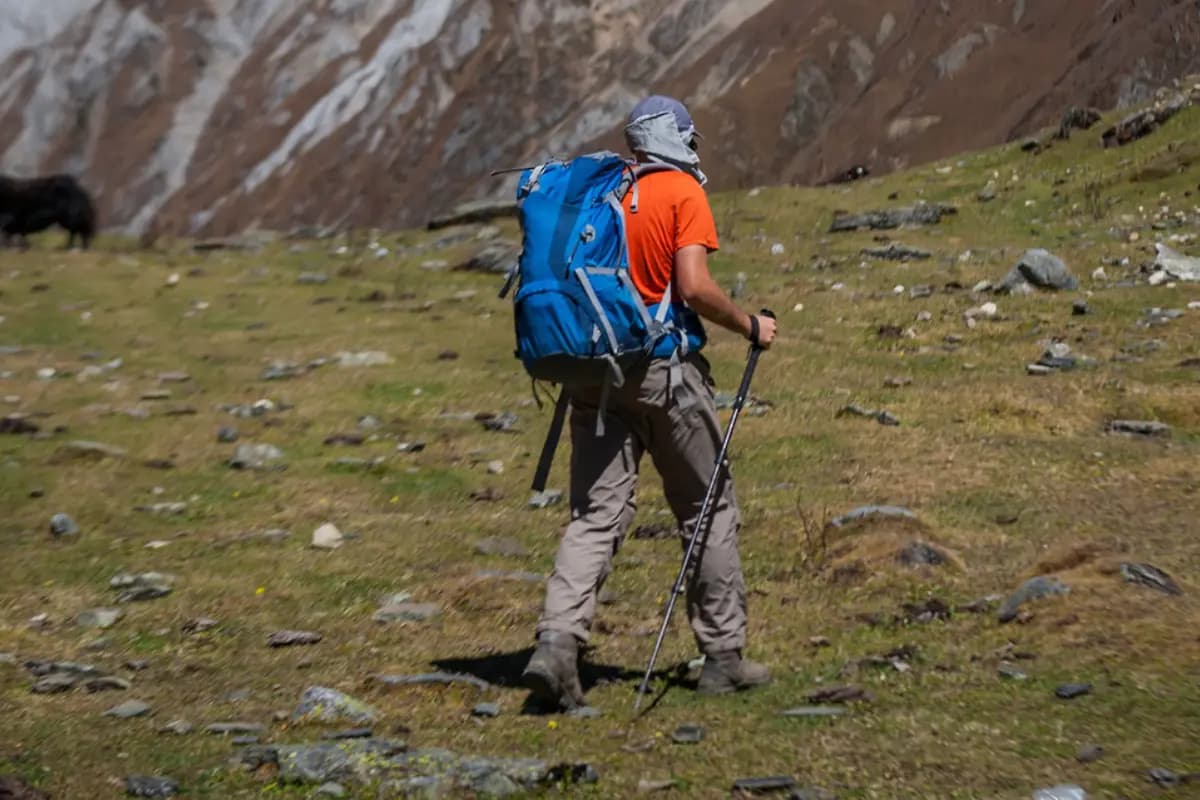
Hiker on the trek in the Himalayas, Manaslu region, Nepal
Chumnubri Rural Municipality Entry Fee
The local government of Chumnubri Rural Municipality charges trekkers a small entry fee to pass through its area. This is a local tax. It is not a conservation permit, and it is not an immigration permit.
Everyone pays this fee, whether you trek the Manaslu Circuit or the Tsum Valley. You pay it at the entry point in Jagat or at a nearby checkpoint. Your guide or trekking agency usually handles the payment for you as part of your package.
Tsum Valley Restricted Area Permit
The Tsum Valley is a separate restricted zone. If you trek only the Manaslu Circuit, you do not need this permit. You need the Tsum Valley Restricted Area Permit only if you add the Tsum Valley to your trek or visit it on its own. The Department of Immigration issues it through a registered agency. It is issued by the Department of Immigration through a registered agency. It is valid for the restricted zones towards Lokpa, Chhekampar, Nile, and Mu Gompa.
Manaslu Circuit and Tsum Valley Trek Permits Cost
Cost of permits is determined on a per-person basis and varies according to three factors; the route taken, the season and number of days spent in restricted areas. Some charges are fixed while others vary depending on the season and duration of the trek.
Which Fees Apply to Your Route
Manaslu Circuit only: These include the permit for Manaslu Restricted Area (RAP) along with the Manaslu Conservation Area Permit (MCAP) and the entrance fee to Chumnubri Rural Municipality. In case the route ends with exit through Dharapani to Annapurna Conservation Area, one needs an Annapurna Conservation Area Permit (ACAP).
Tsum Valley only: The Tsum Valley Restricted Area Permit (RAC), MCAP, and the Chumnubri entrance fee are necessary for this trip. ACAP is required only when entering the Annapurna Conservation Area.
Combined Manaslu Circuit and Tsum Valley: You require everything mentioned above, both Manaslu RAP and Tsum Valley RAP. This is the only trek that requires two Restricted Area Permits.
Fixed Fees vs Duration-Based Fees
MCAP, ACAP, and Chumnubri entry fee are constant charges and are not affected by season and number of days of your visit. There will be no difference in the cost whether you travel for 10 days or 20.
Manaslu RAP and Tsum Valley RAP are two charges that vary depending on season and number of days spent in the restricted area. The Manaslu RAP and Tsum Valley RAP both have a basic charge for the first 7 days, then there is daily charge for each day beyond the first seven days.
Permit | Applicable Route | Foreign National | SAARC National | Seasonal Conditions | Additional-Day Charges |
Manaslu RAP (peak, 7 days) | Manaslu Circuit | USD 100 | USD 100 | September - November | USD 15 per extra day |
Manaslu RAP (off-season, 7 days) | Manaslu Circuit | USD 75 | USD 75 | December - August | USD 10 per extra day |
MCAP | Manaslu Circuit and Tsum Valley | NPR 3,000 (approx. USD 23) | NPR 1,000 | None (fixed) | None |
ACAP | Manaslu Circuit (exit via Dharapani) | NPR 3,000 (approx. USD 23) | NPR 200 | None (fixed) | None |
Chumnubri entry fee | Manaslu Circuit and Tsum Valley | NPR 1,000 (approx. USD 8) | NPR 200 | None (fixed) | None |
Tsum Valley RAP (peak, 7 days) | Tsum Valley | USD 40 | USD 40 | September - November | USD 7 per extra day |
Tsum Valley RAP (off-season, 7 days) | Tsum Valley | USD 30 | USD 30 | December - August | USD 7 per extra day |
What You Will Actually Pay
Manaslu Circuit is done by most trekkers in the month of October. It usually takes around 12 to 14 days and in those days, about 10 to 12 days are spent in the restricted zone.
Manaslu RAP is priced at USD 145 to 175. MCAP of USD 23, ACAP of USD 23, and Chumnubri charge of approximately USD 8 will be added in. So, the total amount you'll have to pay for a permit is between USD 200 and 230.
For adding Tsum Valley, you have to pay for the second restricted area permit. A Tsum Valley leg of 10 to 12 days is priced at USD 61 to 75. This increases your total permit cost to USD 260 to 305.
Tsum Valley has its own reduced permit fee which is independent of the Manaslu RAP. The trekkers who use both routes have to pay for two restricted permits instead of just one.
Permit charges by the government can vary. Always confirm with the trekking company prior to your booking.
Can Solo Trekkers Obtain Manaslu Circuit Trek Permits?
Yes, but you must follow certain rules. On 22 March 2026, Nepal's Department of Immigration announced that individual foreign travelers can now get restricted-area permits. You no longer need a minimum of two people to apply.
"Solo" here means the number of tourists on your permit. Two rules still apply. First, you must hire a licensed guide. You cannot walk the restricted zone alone. Second, your permit must come through a registered trekking agency. The agency organizes your schedule and manages emergencies.

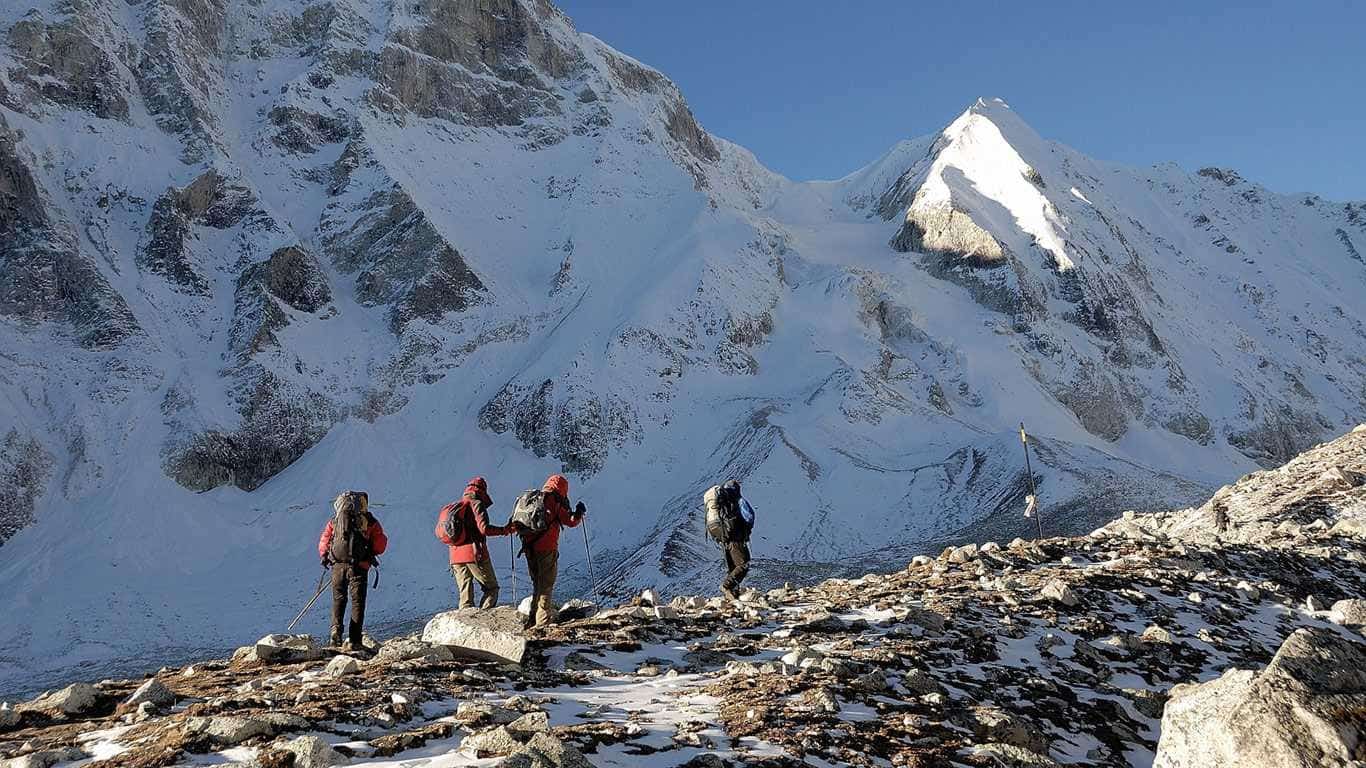
On the way to Larke Pass
The guide-to-trekker ratio is one guide for every seven trekkers. Checkpoints turn back anyone without a licensed guide and the correct agency-issued permits.
Government websites do not always update their policies right away. Confirm the current solo trekking rules with your trekking agency before booking. They will explain exactly what applies to your trip.
Can You Apply for Restricted-Area Permits Independently?
No. The restricted area permits should be handled by the registered trekking agency. The agency sends in your application to the Department of Immigration, gives the guide's license numbers, and sorts out the paperwork for you. You cannot simply go to the immigration department yourself.
This is because restricted areas are sensitive border regions, and the government wants a registered agency to be responsible for the trekker, the guide, and the planned route. The agency ensures that the payments for all conservation area fees and local taxes are made.
Documents Required for Manaslu and Tsum Valley Permits
Your agency will ask for the following documents. The exact requirements can vary slightly, so confirm with your operator.
Passport copy: A copy of the scanned/photographed passport page containing your photograph. It should be valid for at least six months after your trekking dates.
Information about Nepal visa: Copy of your visa to Nepal or arrival information. You are likely to receive a visa on arrival if you are a foreign national coming to Nepal. The visa number will be needed in the online permit application.
Passport-size photographs: Two digital or printed photographs in jpeg format.
Trekking dates: Date of arrival, start date of trek, and end date of trek.
Itinerary: Day-by-day itinerary of your trek.
Guide details: Name and license number of your licensed guide.
Insurance details: Travel insurance details for altitude trekking and helicopter rescue.
Emergency contact: Emergency contact back in your country.
How to Get Manaslu and Tsum Valley Trek Permits
The process is straightforward if you work with a registered agency. Here are the steps.
Step 1: Choose a Registered Trekking Agency
It is important to confirm that the travel agency you select is listed with the Nepal Tourism Board and has experience with restricted trekking permits. You should also ask if the permit fees are part of the package price or if they have to be paid separately.
Step 2: Confirm Your Trekking Route and Dates
You need to first decide if you are going to walk the circuit around Manaslu alone, Tsum Valley alone, or both. Check the number of days you will spend in each restricted area. It's important since the Restricted Area Permit is calculated based on the duration. Overlooking the number of days may result in extra expenses or permit validity problems.
Step 3: Submit the Required Documents
Forward copies of your passport, photographs, visa details, and itinerary to the organization. The organization will verify all the documents you have sent are correct before applying.
Step 4: Have Your Agency Arrange the Permits
The agency then files the RAP application to the Department of Immigration. In addition, it also facilitates the MCAP, ACAP, and Chumnubri entry fee payments wherever required. However, in the case of the Tsum Valley, the RAP is applied separately. These fees are paid by the agency and the permit is acquired. Normally, the process takes two to three days but you may need some extra time during the peak season.
Step 5: Check Your Permits Before Departure
When you have received your permits, examine every single detail. Ensure your name, passport number, the dates on which you plan to trek, the route coverage, and the validity period of the permits are all correct. Make sure the name and license number of the guide are all correct.
Manaslu and Tsum Valley Trek Permit Checkpoints
Permits will be checked at different stops along both trekking trails. The key checking spots for the Manaslu Circuit Trail are Jagat, Philim, Namrung, Samagaon, and Dharapani. For Tsum Valley, the checking stations are Jagat, Lokpa, and Chhekampar. It is the job of your guide to present these permits at the respective checkpoints.
Do You Need a TIMS Card for Manaslu and Tsum Valley?
No, you don’t need a TIMS card for the Manaslu Circuit, the Manaslu-Tsum Valley Trek, and the Tsum Valley Trek. But earlier, you needed to obtain the card from a registered trekking agency and also go with a licensed guide. The cost for a TIMS card is NPR 2,000 for non-SAARC Nationals and NPR 1,000 for SAARC Nationals.
Additional Permits and Special Permissions
There are some activities that require specific permissions. Activities like documentary filmmaking, commercial photography, and research work will need specific permissions from the appropriate government authorities. If you are planning on making a film in the monasteries or conducting activities, then there might be a charge specifically for that particular monastery. Specimen collection is not allowed unless you have a research permit. You will also need permission if you intend to use drones for your activity.
Important Rules to Know Before Your Trek
The regulations in the restricted areas are tough. The validity of the permits issued to you will be limited only to those specific dates and the particular route alone. Any deviation from this route without the prior permission of the authorities is not allowed. The permits issued to you will be for a single entry. In case you leave the restricted area and come back, you may need a fresh permit. You must carry the copies of the permits all through your travel. Trekking without permits will lead to heavy penalties, disqualification from the trek, and even rejection of permits in future.
Conclusion
Both the Manaslu Circuit and the Tsum Valley are restricted areas. Both require permits to enter into them. You require the Manaslu RAP, MCAP, ACAP, and Chumnubri permit fee to enter the Manaslu Circuit. You require the Tsum Valley RAP, which is less expensive than the Manaslu RAP. If you wish to take a combined trip, then all four permits are needed. Fees vary according to seasons and number of days spent in the restricted area.
There have been changes in the regulations for 2026. Individual travelers will be allowed to apply for restricted-area permits; however, an experienced guide and an authorized agency are a must. The maximum guide-to-trekker ratio is 7:1.
Arrange your documents and permits and make copies to carry along. Once the documentation is done, you can concentrate on the journey and its experience.
Plan Your Manaslu Circuit Trek With Us
Planning to have a Manaslu circuit trek or Tsum Valley trek in 2026? Please get in touch with us through WhatsApp at +977-9851042334; we would be glad to assist you to organize your trek as per your convenience and capacity.