

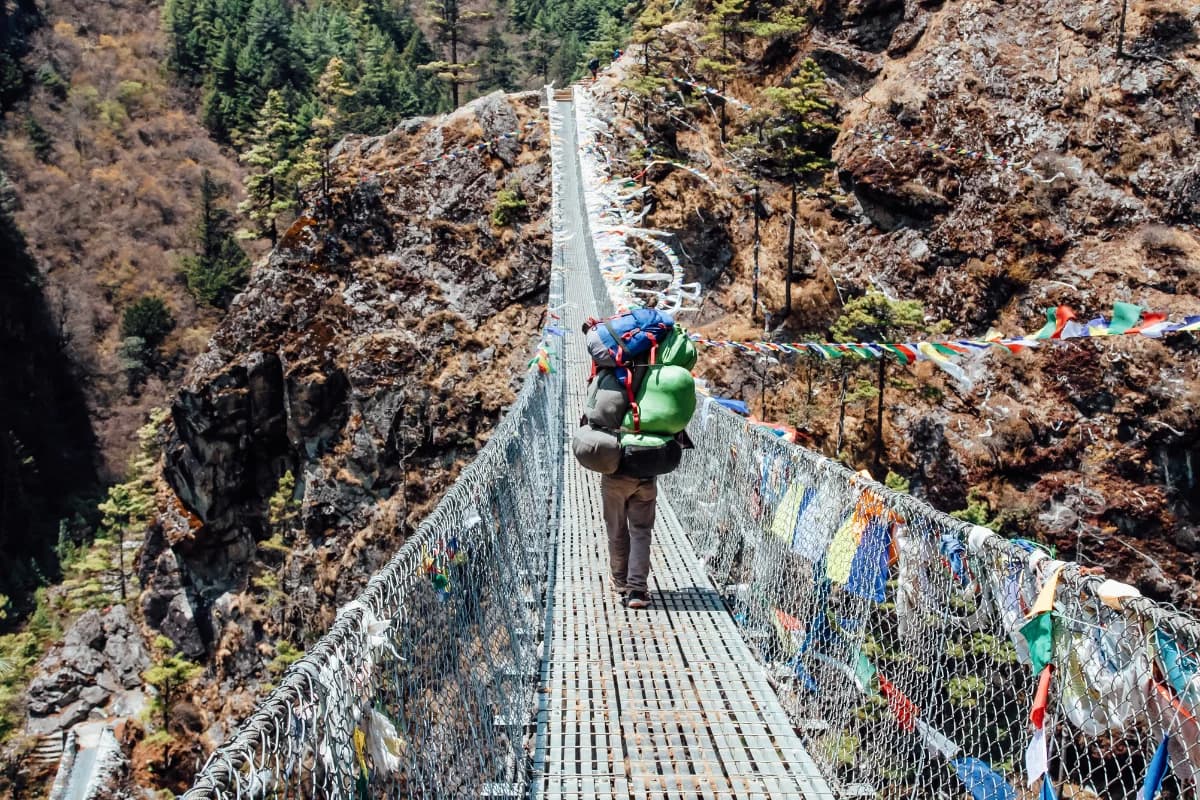
If you pay close attention to the duffel bags along the trails in Nepal, you'll notice a name on each bag. The bag belongs to a trekker, who has a porter behind him with his belongings, which include clothing, sleeping equipment and more.
You should have the chance to see porters carrying the things of the trekkers like sleeping bags, additional clothing, boots, cameras, and so on both from Lukla to Everest Base Camp Trek as well as on the trails.
In many ways, one of the most misunderstood elements of trekking in Nepal is how much weight a porter should carry, where these porters are in Nepal, and the significance of these limits.
This guide discusses Nepal's porterage and Sherpa weight limits, where these limits are from, why some companies impose lower limits and what trekkers should know before booking a trek.
But it's not about guesswork, and it's essential to know the criteria of trekking companies and government authorities as well as porter welfare organisations.
Most trekkers don't really consider porter weight limit until they get on the trail and they see one porter carrying a lot more weight than the rest. By that time, they have already made up their minds about the trekking company to hire.
It is better to know these constraints before selecting your itinerary and trekking company. Therefore, you can determine the correct questions to ask prior to booking.
Porter vs. Sherpa: Clearing Up the Confusion
Before we get into the numbers, let’s clear up a common confusion among first-time trekkers. Sherpas and porters are not the same thing, although the two terms are often used interchangeably in travel blogs.
Similarly, due to its extensive history of application to mountaineering in the Himalayas, the term "Sherpa" has sometimes been applied incorrectly to any person working in the high mountain areas.
As a result of this adaptation, and the long working history of various Sherpa groups on Everest expeditions since the 1920s, the term "Sherpa" evolved into a high-mountain word, being applied to high mountain activities and jobs in general and to climbing Sherpas, expedition Sherpas, trekking Sherpas, or anyone else working at high altitudes globally.
In the Everest area, the many professional mountain guides and porters are ethnically Sherpa too. On routes in the Annapurna, Manaslu, and Langtang valley, however, there are plenty of porters who are from other communities like Tamang, Gurung, Rai and Magar.
Porter, on the other hand, is a job title and not an ethnic term. Porters carry luggage, camping gear, food, and other items of trekkers between the stops. For a normal teahouse trek, a porter's job is basically to transport the bag safely from Point A to Point B on a day-to-day basis for the duration of the trek.

How locals carry weight in Everest Region
An individual employed as a Sherpa on a mountaineering expedition may have a very different job. These may involve knot repairs, transport of oxygen and equipment and operations in high-risk terrain like the Khumbu Icefall and above Base Camp.
The Official Porter Carrying Weight Limit in Nepal
One figure that many trekkers do not know is the 35 kilos (77lbs) that is usually mentioned for porters in Nepal.
This figure is associated with Nepal's labour regulations and is not limited to the tourism sector.
It is not however, consistently enforced on trekking routes and is said to be more of a guideline in practice.
For villages with no access roads, Independent cargo porters also transport heavy materials, including construction supplies and gas cylinders. Their activities do not necessarily relate to trekking tourism and can be different.
That's apart from trekking tourism, which in part explains why “35 kilograms” is not all that. The number that trekkers should care about is not the one set by the government and enforced by the police; rather, it's what any specific trekking company imposes on itself.
What Reputable Agencies Actually Enforce
Talk to a few trekking agencies in Kathmandu, and you'll see that there's a minimum and maximum limit for porters to carry, between 20 and 30 kgs.
A phenomenon can be observed among companies that are really concerned with the welfare of their porters:
Many agencies will state that their porter limit is 20-25 kg. This does not mean that the government imposed trekking limits; it is company policy.
Individual duffel weight: Many operators require their trekker to have a duffel bag of less than about 10-15 kg, as it could end up being carried by both of them.
Shared Porter system: In this, perhaps each trekker has a 10 kg duffel, and both are able to get one porter to carry about 20 kg. This will keep your load at the low end of the range that people commonly use.
At higher levels: Some operators and welfare organisations suggest that any loads above 4,000m should be lowered, as carrying out heavy bags becomes more difficult at higher levels.
They are not hard codes all lawyers must adhere to. They are limits that individual companies decide to use and set below the figures that they feel are not suitable for trekking conditions.
Porter Weight Limit at a Glance: Comparison Table
Source / Standard | Recommended Max Load per Porter | Notes |
Nepal Government (official) | 35 kg (77 lbs) | Set by national policy; not actively enforced on trekking routes |
IPPG (International Porter Protection Group) | 20-25 kg at altitude | Founded in 1997; widely cited welfare benchmark across the industry |
Typical reputable trekking agency | 20-25 kg | Applies to trekking porters carrying client duffels |
Domestic flight baggage allowance (for comparison) | 15 kg | Lukla and other mountain airstrips; useful reference point for packing |
Per-trekker duffel allowance (most agencies) | 10-15 kg | One porter typically shares this between two trekkers |
Independent cargo porters (non-tourist) | 40-80+ kg | Common in practice for village supply runs; separate from trekking tourism |
Why 20 kg and Not 35 kg? The Altitude Factor
Responsible operators often have voluntary lower limits to promote porter welfare, while a company can refer to a higher legal limit.
At high altitudes, anything over 30kg should be considered problematic in terms of the safety of the porters.
The same load on 1400m vs. 5000m is different physical exertion, particularly if the trail is steep and snowy and difficult.
As you rise in elevation, you have less oxygen available.
Working at an altitude of about 4,000 m, the amount of oxygen in the air is substantially reduced compared to what it is at sea level.
It takes physical strength to carry a heavy load and this will be increased at altitude where there is less oxygen to draw upon.
Porters can work for many hours per day on the trek as opposed to trekkers and doing the same kind of work day after day.
The cold weather, steep terrain and difficult trail conditions can bring additional physiological stress.

High altitude porter carrying load
A heavy pack can also have an impact on balance on icy sections, exposed ridges and unstable areas around high passes as Thorong La and Cho La.
A porter with a 30 kg load on a steep or unstable slope is very different to a trekker with a 5kg daypack.
A porter on a 12 day trek at the base camp could work taking loads back and forth daily for nearly 2 weeks, without much rest between days.
Potential long-term risks involve musculoskeletal injury, including the knee and back, as particularly heavy loads are lifted repeatedly over a many years.
These limits aren't just about comfort. They are designed to decrease unnecessary strain and ensure that porters can work safely for the long run.
A Short History of Porter in Nepal
For most of the trekking history of Nepal, there was no formal concept of a ‘Porter Weight Limit'. In the Khumbu and Annapurna areas, tourism grew dramatically in the 70s, 80s and well into the 90s, and for many years porters were treated as a resource.
They were paid by the weight of porters rather than paying for the job itself. Porters were expected to adapt to paying trekkers, whatever the circumstances, with little attention to how a trip was marketed or sold.
It was in the mid-1990s that conditions started to get more attention. Doctors, mountaineers, and other people working in the Himalayas increasingly raised concerns about injured and sick porters who often lacked adequate support.
However, there has been a genuine improvement in the situation since then with mid-range and premium operators, which in part compete by ethical means.

Local porter carrying loads in doko
The adoption of a mandatory guide policy in 2023 in Nepal provided an additional level of formalization for trekking employment, further increasing the number of licensed jobs and fewer informal ones.
The improvement has not even been distributed. Even the budget operators, who don't seem to be so forthcoming about the pay levels for the porters, still skimp on insurance and equipment in just the areas that the IPPG was formed to remedy.
It's not a solved problem, but rather a gradual and imperfect remedy that, well, hikers can help to either create or destroy by directing their business.
Porter Weight Limit by Popular Trekking Region
Different trekking routes follow different areas in terms of terrain, infrastructure, and altitude, and the load of the porters may differ accordingly.
The following table covers the weight limits that a typified trekking firm may expect in various areas.
Region | Typical Max Load per Porter | Why |
Everest / Khumbu (EBC, Gokyo, Three Passes) | 20 kg or less above 4,000m | High altitude for extended stretches, exposed passes, cold; IPPG runs a dedicated rescue post in the Gokyo valley |
20-25 kg | High trekker volume and well-developed teahouse infrastructure, but Thorong La pass (5,416m) still demands stricter loads for that section | |
Manaslu / Tsum Valley | 20-22 kg | Restricted-area permit route with less infrastructure; loads often trimmed further near the Larke La pass (5,106m) |
Langtang | 22-25 kg | Lower average elevation on most of the route than Everest or Manaslu, allowing slightly higher loads on non-pass days |
20-25 kg | High-altitude desert terrain; loads sometimes shared with pack animals (mules, horses) on certain sections, reducing pure porter-carried weight |
Porter Wages and Tipping
Fair pay and working conditions are also closely related to porter welfare.
In Nepal, daily porter wages range from NPR 1,000 to NPR 2,000, with potential variations depending on the route, season, and whether the porter is being hired directly or through a porter company.
Many trekking companies offer porters a fixed daily wage, and the tips are paid directly by trekkers.
Tips are not a source for a fair base wage. Tips can be an additional way for trekkers to show appreciation, but they should not replace proper wages.
If you find one price on trekking that is unusually low, worth while checking it out. In some cases, lower costs can be an indicator of different porter salaries, insurance, equipment, or another type of service provided.
Who Sets These Rules: IPPG, TAAN, and the Government
International Porter Protection Group (IPPG): IPPG was founded in 1997Dr. Jim Duff to address the health, safety, and welfare concerns of porters in the mountains.
More than just porter weight limit are included in its recommendations. They also cover suitable clothes, cover, food, medical care, insurance, and assistance in time of emergency.
TAAN is the umbrella trade organization of licensed trekking operators in Nepal. Membership obliges companies to satisfy minimum welfare standards of their employees, including porters, good salaries, insurance, and sufficient equipment.
The implementation is different with every company, yet a decent initial selection criteria when looking at booking someone is picking a TAAN-registered operator.
Some companies have different standards to follow and you can take a look if the operator has registered with the various trekking and tourism associations as one of the valuable inputs of your research.
These rules are granted by government policy and regulations. There are three groups that have different roles: government authorities, industry associations, and independent welfare organizations. There is no single weight figure, though that is universally used in each and every Trekking condition.
Booking a trek is more than just signing up for a course and a cost. You're also selecting the work standard that will apply to those who will be carrying your gear.
What Happens When Limits Are Ignored
The question of porters' welfare is one of abstract knowledge until the physical consequences of portering too many loads are understood.
Repeatedly carrying heavy loads can increase the risk of musculoskeletal problems, including back, knee, and shoulder injuries.
Altitude illness is another risk at high altitudes for porters who are poorly acclimatised, inadequately provisioned for the trip and who are under pressure to complete an intensive program.
Porters working on high passes need suitable clothing and footwear to protect them from cold, snow, and exposure.
When working on steep and exposed surfaces, or when carrying heavy loads that may cause slips and falls, always be cautious.
Porter accidents and fatalities receive less attention than those involving trekkers and climbers, but porter safety remains an important concern.
This is why porter weight limit should be a critical consideration in your trek plans. The way a company handles porter loads can give you a lot of information about how committed they are to staff welfare.
How Porter Loads Are Actually Weighed and Assigned
Procedurally, it appears as follows on a successful trek:
Pre-trip briefing: The company informs the group of a bag weight restriction before the trip with most people asked to limit their bag to a targeted weight range.
Weigh-ins: Duffel bags can be weighed prior to trip with simple hanging scales and be sure to stay within the agreed limit.
Load assignment: A single porter is usually assigned two duffels of trekkers, and this brings the weight just under 20 kg, which is within the safer range mentioned above. If trekkers have very heavy or very specific gear, they might need to organize a second porter.
Daily spot checks: For longer treks loads may be redistributed if a porter is carrying too much or if extra supplies are required en route.
Porter-guide split: There are also porter-guides, guide porters that walk ahead of the group with a lighter load. This may also include guiding and porter duty, depending on the operator.
Not all operators use the same system for weighing and load assignment; hence trekkers should inquire about this before they book with their chosen company.
Common Misconceptions Worth Clearing Up
Some misconceptions regarding porter weight do circulate amongst trekkers and each one of which is worth getting to grips with.
“The 35 kg is safe as it is the government limit.” Being legal doesn't make it a good idea. The 35-kilogram number was chosen as a broadly applicable carrying limit not one purpose-made to accommodate multiple, repeated, high-altitude carries during multi-day treks.
“The porters are quite used to carrying heavy loads; it is not that much of a bother for them.” This is not the case. Experience and physical conditioning can help but there is no way to remove the dangers of carrying too heavy a load.
“If I reduce the number of porters, then I am supporting the local economy on a per-person basis. Increased numbers of porters and lighter workloads can help allocate labour and provide employment opportunities. Focusing on fewer people to help with logistics, risks are just transferred to fewer people.
Any underserved company is generously thanking ‘tipping’ for, in his view, the many ways his creators are filling in the missing pieces. Tips come in handy but can be unpredictable and certainly cannot be relied upon. A porter's livelihood and safety should not rely on the benevolence of a specific group of a trekking party in any one season.
Packing Smart: How Trekkers Can Help
Most trekkers have more control over porter loadings than they realise. For every kg that comes out of your duffel bag, one kg does not have to be carried towards a mountain. Here are some tips on getting used to a few practices:
Pack below the maximum limit. If 10-12 kg is the maximum weight your company lets you use, do not exceed it; it helps to be slightly under the maximum weight allowed in the bag.
By their nature, trekking equipment is heavy. Take layering footwear and clothes that can double up instead of having an outfit for every possible weather condition.
Pass on the ‘just in case' materials. The amount of weight that adds up fast is full first-aid kits, backup electronics, and printed guidebooks. Most teahouses and good operators have their own set of group first-aid and emergency equipment.
Personally carry the daypack. The trekker is responsible for their own snacks, camera, rain gear, and water on the walking day. This also facilitates independence should the trekker at any time be separated from the porter on the trail.
Give instead, don't throw away. If you're one who ends up stuffing extra clothes in your suitcase, numerous trekking areas have used-clothing donation points; old down jackets, gloves and boots are never rejected by a porter or any person in need.
You may end up carrying more food and other souvenirs along the way, giving your duffels a bit more weight as the days go by. Keep an eye on the weight throughout the trip.
Questions to Ask Before You Book a Trek
Because porter policies can vary between companies, trekkers should ask a few questions about porter welfare before booking.
What is the weight that could be carried by each porter?
How many trekkers' bags does each porter carry?
Do you give porters appropriate clothing and footwear for working at high altitude?
Is your porter insured, including coverage for high altitude emergencies and rescues?
Are your porters paid a base salary and tipped separately?
Does your company have a registration with TAAN and do you uphold to recognized porter welfare guidelines?
A good trekking company will not have a problem answering these questions.
How This Works on an Organized Trek
Himalayan Trekkers’s porter system is adopted on a load-sharing basis. Duffel limits are determined and agreed prior to departure, and two trekkers' bags are usually handed to one porter.
We aren’t forcing our porters to shoulder the maximum weight sometimes encountered under general porter regulations.
Our Porters follow the type of the trekking route, the height and conditions of the route and insurance is included in our trekking packages.

Himalayan Trekkers duffle bags allocated for the trekkers
We feel that these value standards should be simple components of sound trekking activities and not regarded as a "plus".
However, because porter welfare standards can vary between operators, we believe it is important to explain our policy clearly.
Final Word
A hidden part of the Nepal experience is the load the porters bear while transporting your gear.
Whatever legal or regulatory limits may apply, individual trekking companies may set their own lower limits based on their porter welfare policies.
The limits of many responsible operators come to be around 20 to 25 kg. There has been an effect from porter welfare groups, industry-set standards, and the awakening of responsible trekking.
There are simple steps to be taken by trekkers. Pack light and before paying a deposit, ask your trekking company about porter services.
Make sure a company can provide clear answers regarding porter weights, insurance, equipment and working conditions.
There will still be mountains to look at, so select an operator that will help ensure the adaptation is safe and responsible for all involved.
All one has to do is inquire about the porter weight limit before booking. From the time you book the trek, a responsible operator should consider the welfare of the porters seriously.