

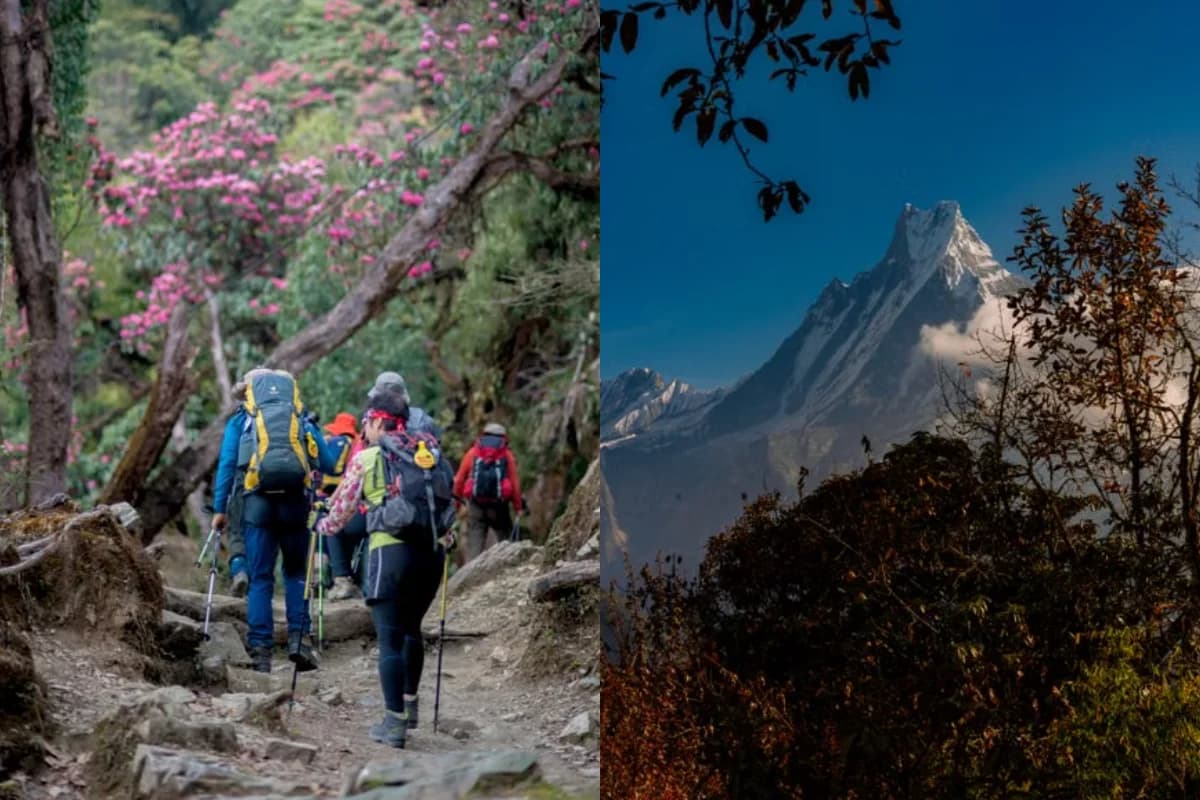
When trekking in Nepal, you look for two seasons a year: spring and autumn. When you ask ten trekkers which one is better, spring vs. autumn, you get 10 different answers. This is because it's a good season in both. They all provide different types of magic.
Spring or Autumn? This is the major query among the trekkers. All they want to know is when the best time is to trek in Nepal. That's why we have created this guide.
We have provided guidance through both windows on routes in Nepal, Bhutan and Tibet. As the years have passed, we know that the “right” season is actually the one you want.
The answer will be different for a photographer who wants to capture razor-sharp peaks, versus one who wants to capture flowers and festival lights. That is why we created this guide, so that you can make your own choice, not follow the herd.
Why the Season You Pick Actually Matters
Trekking in the Himalayas is not an ordinary hike in the hills. You will trek through a region of high mountains, with no black-paved road or fancy houses for several days. The weather can change there in an hour. The sun can quickly change to a snow squall by lunchtime. That's why the timing of your trip is crucial.
There are four seasons in Nepal. In winter, the passes are capped with snow. Monsoon soaks the trails in rain from June to August.
That leaves two viable seasons when there is weather that could work: in the spring and autumn. Most trekkers arrange the entire trek around one of these two periods.
There is still plenty of trekking that can be done in the winter months over some lower trails, whilst many high passes are blocked with snow for the season.
You can trek in the monsoon period as well, but the bad weather, leeches, and hazy skies make it a poor choice for most. It is this reason that the trek calendar in Nepal is condensed to these two good windows every year.
Even the sound of your boots on the trail is different from soft mud in the spring to dry crunch in the fall. We will explore each of these individually.
Spring Trekking in Nepal (March to May)
Spring starts cool and warms up as it goes. Early March can still be cold, a little bit wintry, particularly when you're above the valleys. The cold fades with every week, though. Snow retreats. Meltwater flows in streams. Until hillsides turn from brown to green, almost overnight.
Spring Trekking Weather and Temperature
The weather in spring in Nepal is generally pleasant, especially during the day, in the lower and middle mountains. You will still need a jacket in the early mornings, but sometimes that sun is the real deal as late morning nears. However, by midday, many trekkers can only wear t-shirts.

Clear view of mountains seen from Ghandruk Village
It's different at the top. Even high up at 4000 m, nights can still get below freezing, even in midspring. Thus, a warm sleeping bag and correct insulation layers remain essential for all people aiming towards a base camp or high passes.
Short afternoon showers may occur as spring moves to summer but typically only last for a short period of time.
Rhododendron Season: Nepal's Best Flower Trekking Months
March and April are when the rhododendron, the national flower of Nepal, fills the mid-hill forests with its flowers. Whole hills are painted a shade of red, pink and white. Trekking in one of these flower forests are among the most impressive experiences on foot around the world.
Here is a particular phenomenon from the Annapurna region and the lower parts near Everest. You go under a canopy of a thousand blossoms, and new green leaves grow all around. The entire hillside seethes with vitality.

Rhododendron blooming with Mt. Fishtail in the background
The Ghorepani Poon Hill trek fully blooms during the spring season in Nepal with more than 3 colors of rhododendrons.
The bloom doesn't show up everywhere at the same time, either. High forests bloom earlier with lower forests beginning to bloom in March. Gradually, the color shows up the hills as the weeks go by. Thus, a visit in early spring will provide you with fresh growth and the first bloomings. A trek later in the season will bring you the forest in its fullest.
This colour is simply irresistible to all photography enthusiasts. It's not rock and snow all the time. It's got texture to it, it's got layers to it, it's got life to it.
Spring Trekking Trail Conditions Explained
By springtime, the lower and middle elevation areas have mostly lost any winter snow cover. Trails are mostly dry and have easy accessibility.
The passes and base camps are where loose snowpack remnants may persist, particularly for the first few weeks of the season. While it may affect speed a bit, it does make for some drama in the landscape.
Rivers are a bit higher due to melting snow but not extreme conditions most years. Bridges and paths are typically quite fine, as there are not as many hikers during the winter.
On popular treks, such as the Everest Base Camp, the trails are usually maintained well, because the teahouse owners prepare the villages prior to the onset of the trekking season in spring.
Wildlife Sightings During Spring Treks in Nepal
For wildlife enthusiasts, spring is a good time. The higher temperatures cause increased animal activity.
Between areas of protection (Sagarmatha National Park, Annapurna Conservation Area etc.), you have a good opportunity to sight Himalayan tahr, musk deer and various kind of Pheasant etc. It's a favorite time for birders, as numerous birds are out and in view.
Nepal's national bird, the Danphe, can be sighted at high altitudes of Nepal in Spring time. It has a brilliant plumage in contrast to the green slopes. On lower routes such as Annapurna, langur monkeys also make an appearance in the lowest part of the trail, which is heavily forested.
Who Should Choose a Spring Trek in the Himalayas
Spring is a great season for the color and the bloom and anyone who enjoys a little more warmth on the trails. Not just for mountaintops, it's ideal for photographers looking to record woods.

Mt. Annapurna view in Spring in Nepal
For those who prefer less traveled routes and do not want to find everyone at every vista point, spring is the time. It is also a great choice for a walk with children or older family members, as it tends to be slower and has more pleasant weather.
Autumn Trekking in Nepal (September to November
When it comes to autumn, it's about sharpness; back to spring, it's about bloom. This season starts immediately after the monsoon rains reduce. Air is cleansed. The skies turn a rich shade of blue.
Fall is considered to be the most stable season for trekking in Nepal. There can still be a lot of monsoon moisture left in September, especially during the first fortnight.
Autumn Trekking Weather: Why October Is Peak Trekking Season
However, the sky opens up pretty consistently in October. The days grow warm and sunny. Nights remain cool, and at lower elevations and mid-slope there will be no severe cold.
Meanwhile, further up, it's getting cooler in the fall. Toward the end of November, the nights at base camps or mountain passes get very cold. Daytime trekking conditions nonetheless remain excellent, as it continues to be mostly dry and sunny with little wind most days.

Clear view of Mt.Fishtail during Autumn in Nepal
Precipitation is not too common in the fall, and October is considered the best month of the year to trek anyplace in Nepal.
Also, take note of the air quality. At lower elevations, the afternoons can be warm, even hot on open areas of the trail. Afternoons are lighter in the autumn, but still bring a bit of chill air on a sunny day. Both are fine, but if you prefer cooler day hiking, then fall might be for you.
The Views That Define the Season
As soon as the monsoon passes by, the dust and haze scatter and you get remarkable visibility. In the distance, there are miles of mountains. If the peaks are obscured or indistinct during other months, they stand out clearly against the sky.
If you're taking the trek towards Everest Base Camp, Annapurna Base Camp or one of the bigger vantage points, then autumn offers you the biggest chance of spotting the big peaks in their entirety. The sunrises and sunsets are especially striking, as golden light shines on snow-covered summits.
Often, first-timers report seeing the first time a clear view of Everest or Annapurna in the autumn many years after their trekking trip. It is the time of year when every ridge can be seen and all the snowfields.
Autumn Trekking Trail Conditions
Trails may be a little muddy from the end of the monsoons through early September, primarily at lower elevations, right after the monsoon passes. It is cleared soon enough, however. Pathways are dry, firm, and easy to walk on by October and November.
By autumn, the rivers are now calmer than in spring, as most of the snowmelt is over. The combination of bridges and trail infrastructure is also at its best as autumn is the busiest trekking season and trails are better tended to during that time.
It is also a well-booked and busy period for teahouses located on the more used trails, as many trekkers go through them in this time. It translates to meatier menus and, pretty much all things and sundry, better logistics for all people on the trail.
Wildlife Spotting on Autumn Treks in Nepal
Autumn can also provide good wildlife viewing with particular frequency early in the morning, or just before dark. It is also a good time to observe migrating birds that are transiting through the region.
With the skies being so clear, you can see animals from a distance better as well. Occasionally, you may spot blue sheep feeding on the higher ridgelines and, on exceptional days, even a snow leopard track in the upper Himalayan heights. Although rare, they can be spotted in the autumn, during the season when they are more visible.
Who Should Choose an Autumn Trek in the Himalayas
Autumn is the season for people looking to see the clearest view of the mountains. It's a good choice for the shutterbug looking to capture the perfect sunrise over Everest or Annapurna. It is also suitable for those who like hikes to retain a richer experience, and there are plenty of people to share with at the teahouses every evening.

Clear view of mountains seen from Mustang during autumn
But if your dates coincide with Dashain or Tihar, autumn is another unique opportunity to explore Nepali culture. This is perfect for those travelers who seek more than mountains and looking for authentic Nepal.
Dashain and Tihar: Trekking During Nepal's Festival Season
The season of fall is unique because of one thing. September or October are generally the times when the two largest festivals of the Nepalese people, Dashain and Tihar, fall. It's a chance to witness Nepali culture at its best.
The villages on the trekking routes are brought to life. Homes get decorated. People come from far away and join their families together. In certain areas, one can observe some traditional dance, music or rituals that are directly along the walking route.
Homes are lit throughout the festive season by oil lamps and strings of lights, and traditional songs play in the evening throughout a village during Tihar.
Spring doesn't have this cultural heft. On a smaller scale local festivals are celebrated throughout the year, but not on the same scale as Dashain and Tihar.
Spring vs Autumn Trekking: Full Comparison Guide
We've already discussed each season. Let's now compare these two and explore some of the priorities trekkers place.
Weather Comparison: Spring vs Autumn Trekking Conditions
There is a lack of moisture in both seasons. However, there are some distinctions to note.
October typically offers the clearest, most consistent weather of the year, although autumn weather overall is typically pretty good. Rain is scarce. Skies stay blue. The situation is the same every day, making it simpler to plan.
Though solid, the spring is a bit more unpredictable. Clouds cloud up more frequently in the afternoon and a few short showers do appear with frequency, particularly as the season moves towards summer in May. Also, the spring days might be warmer at lower elevations than the Fall days, which some trekkers prefer.

Mount Everest seen during Everest Trek
When weather is a priority, Autumn season in Nepal takes the lead. Spring lows are also not normally a serious problem.
Another minor consideration is humidity. At lower elevations, particularly towards the afternoon, spring air may seem a little thicker. During the fall, there is less humidity and it is lighter during the day, so it is more comfortable for those who like walking for long periods.
Spring vs Autumn Crowds and Trail Traffic
This is where the two seasons really part ways. There's no doubt that autumn season in Nepal is the best time for trekking. Popular trails, such as the Annapurna Circuit and Everest Base Camp, can be busier in the busy weeks of October.
Teahouses tend to get crowded quickly. Popular viewpoints get crowded in the morning rush. Autumn in Nepal is a busy time and if you're looking for a quiet and secluded hike, this is not it.
Spring is calmer. Earlier and fewer people opt for this window, resulting in more open trails. It's easier to make arrangements to go to the teahouses (sometimes little at all planning is required beforehand). You have more space to enjoy viewing the mountains without crowds of trekkers near you.
There's also a practical aspect to this. As autumn is a busy season, flights and teahouses should be booked well ahead of time, particularly the popular trails. During the spring, there is greater flexibility in planning at the shorter end, as well as lower demand for most trails and lodges.
Trail and Snow Conditions Compared
Trails are decent for either season for a variety of reasons.
From October on trails are dry and firm in autumn. The possibility of monsoon mud is still very present in early September and late autumn is the driest time of the year.
At lower elevations, the trails also dry out in the spring, but have the potential to take a bit more moisture from higher elevations that are melting. High passes will still retain snow in early spring (particularly March) and extra care combined with, in some cases, microspikes or trekking poles will be required.
The difference is more seen on high passes like Thorong La on the Annapurna Circuit, or Cho La near Everest. These passes may still contain deep snow in the early spring, which increases the difficulty and time to make a crossing. Most of this snowmelt by April and May. These passes tend to be clear by October during the fall and are thus easier and safer to cross during the season.
Mountain Views and Photography
It really depends on what you're looking for.
Autumn season is a time of clear skies. The sky is clear, the air is pure and the mountain scenery at its very best of the year. Generally, the fall season is the best time for photographing mountains if you're looking for dramatic scenes or big shots.
Spring is a time that everyone thinks of color. The overall landscape is altogether different with rhododendron forests, wildflowers and fresh green slopes. While the peaks may have a slight bit of haze in the air, compared to the fall, the path to the peaks is alive with color and life.

Mt. Ama Dablam during Autumn in EBC Trek
Consider Poon Hill, in the Annapurna region, as an example. During the autumn months the early morning sun will reveal a razor-sharp view of Dhaulagiri and Annapurna South, which barring anything dramatic will be all but denuded of fog in the sky.
That same overlook in the spring is then surrounded by a forest of blooming rhododendron with sunlight illuminating the mountains as well as the flowers.
Festivals and Culture
This is a simple path for Autumn. Along the way, villages celebrate Dashain and Tihar, providing an insight into Nepali culture as well as trekking.
It is not to be compared with the cultural experience of a Spring day. There's not much of a festival in the trekking calendar for these months, and it's less busy with everything happening like normal. When it comes to culture, however, plan your trip around the fall.
Spring vs Autumn Trekking Cost Comparison
Since fall is the busiest time of year, prices may be slightly higher at certain weeks during the fall season. The availability of flights to Lukla, to booking rooms in the teahouse and sometimes even the permits becomes more difficult at the last minute, creating inflated prices or fewer choices.
Spring generally is a bit more budget-friendly. The fewer people that are on the trail, the better the different teahouses can be on the rates, and the less flexible that one is generally.
This is also reflected in accommodation. Some teahouses on popular routes are booked so full during the busiest time of fall that shared rooms may be all that are available.
It is easier to be budget-efficient when you are taking an opportunity in the spring both in terms of expense and in terms of pre-planning.
The availability of guides and porters is similar. The most advanced guides may be booked up in the busiest weeks of autumn; it will be worth it to contact them well in advance.
Wildlife Comparison
Both seasons have an excellent chance to see wildlife in the Himalayas, such as birds, musk deer and tahr. The spring season has a tiny bit of an advantage, with so many of the birds becoming very active during this time. With the clear skies this time of year, animals are easily visible from a distance.
There's no significant lead for either season this time around. The chances of a wildlife sighting tend to be more to do with what time they put the window fan on than what time it is on the calendar.
If wildlife is the number one item on the to-do list, and you value your time with your guide, go slow and quiet, and visit early in the morning or late in the afternoon; more than that will make the difference than choosing one time of year over another.
Local guides often are familiar with the animals' habitat preferences for grazing or resting, so a diversion from the trail can be noticeable.
Final Thoughts on Choosing Your Nepal Trekking Season
Trekking in the Himalayas has its special magic in each of the four seasons, but especially in the fall and spring. Autumn brings clarity, culture and companionship on the paths. Spring has colour, tranquility and just a little more space in your schedule and your wallet.
Our team has years of experience in conducting treks in both summer and winter. We all know that each trekker desires something different, like hikes with a serene environment and gentle light or sparkling views and vibrant village atmospheres. We don't just direct you to the busiest one; we match your trips to a season that really suits you.
Want to get going with creating a plan? Contact Himalayan Trekkers, and we will assist you in choosing the best season, route, and itinerary for your trek.