The Manaslu Circuit Trek will not only give you spectacular mountain views but will also provide you with a local cultural and food adventure. It is important to consider Manaslu Circuit Trek accommodation and food preferences, as there are several types and variants provided in order to make the trip cozy and pleasant.
This blog gives a detailed explanation of accommodation and food in the Manaslu Circuit Trek so that you can plan best during the adventure.
Accommodation options differ a lot as you trek out into the far reaches of the Himalaya and between various terrains. Whether you stay in a rustic lodge or a warm teahouse, the fact is that you will know what to expect, removing any issues about comfort and security.
Likewise, eating out and trying out local foods adds value to the trek and removes the barrier separating one side of the spectrum and the other.
It is also essential to be well-fed and rested to deal with the physical challenges of high-altitude trekking. This guide will provide practical information by telling people how to book their rooms, common meals that people can get, hygiene conditions, and eating habits through tips on these topics.
Whichever type of menu/food you like, whether foreign or native, you still will have some useful tips to ensure your Manaslu trekking is worthwhile and hassle-free.
Types of Accommodation in the Manaslu Circuit Trek
The Manaslu Circuit Trek also has a variety of stays and accommodation. Trekkers spend most of their time in the trekking route staying in either teahouses, lodge or guesthouses, which have various comfort levels given the remote Himalayan area.
They are mainly family-owned hotels where people do not just take shelter, but also get a look at the everyday routine of the people belonging to local communities, which further adds to the immersive trekking experience.
By far, the most widespread accommodation among the trekkers in the Manaslu Circuit is the teahouses. Simple hostels normally consist of dormitories with simple furnishings like beds or cots, wooden tables and benches in the shared dining hall.
All of them are usually warmed by the traditional stoves that burn wood, producing the warm and welcoming atmosphere which is especially necessary in the cold mountain evenings.
A few teahouses in the main trekking trail provided upgraded facilities with attached as well as shared bathrooms with various toilets in recent years, yet hot water may still be rare and can be subject to additional payment.
Manaslu Circuit Trek teahouses are simple in terms of architecture; nevertheless, they are well maintained and their hosts are keen on offering wholesome local food and tea, which aid trekkers in recovering after tedious days of walking around.
In larger villages like Samagaun, Bhimtang and Dharapani, there are usually lodges and guesthouses and they are a bit more comfortable and have facilities as compared to the smaller teahouses in more remote areas.
These facilities can be equipped with separate rooms, electric sockets to charge electronics and enhanced sanitation (eg. western toilet). There is low-level modernization in lodges as some have since introduced Wi-Fi and even small shops that sell basic trekking gear due to an increased number of tourists.
The accommodation in the Manaslu area is rural in normal terms, with a focus on functionality as opposed to luxury. This fits the theme of the trek which involves adventure, cultural immersion, and natural scenic beauty and not luxurious services.
Higher-altitude villages and along the mountain pass, there is increasingly simpler, sparse accommodation. In this case, accommodation may be a basic room with cold shower and basic heating (mostly shared by 1 to 2 people), so trekkers must consider staying in hotels with other trekkers.
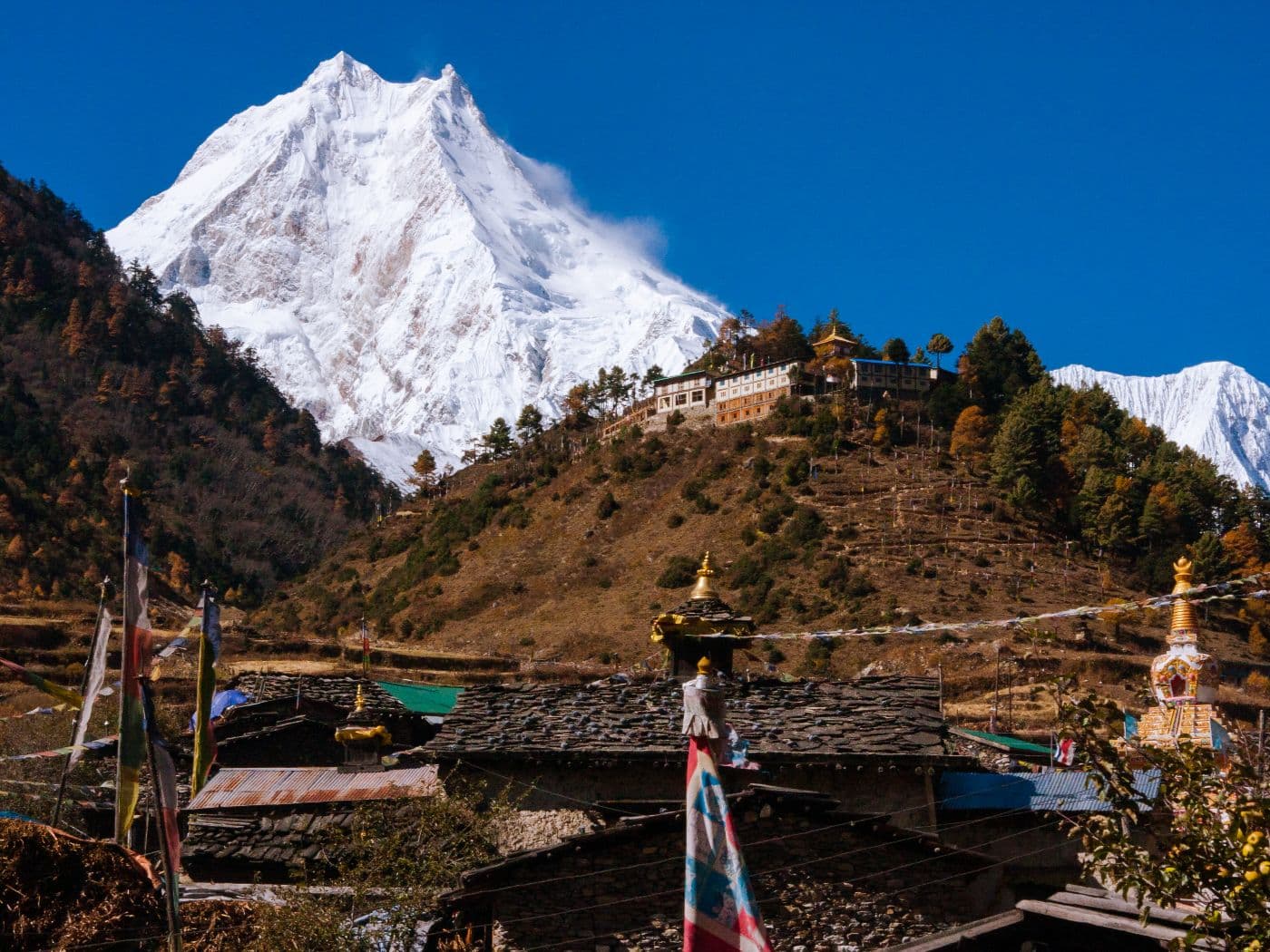
Local Houses of Samagaon Village
Considering the remote location and the cold nature of the Himalayan climate, hot showers and other luxuries are nonexistent, so you must bring a high-quality sleeping bag along with warm clothes so that you can be comfortable.
Also, a lot of teahouses in Manaslu are constructed using local materials such as stone and wood, which are supposed to be able to survive the mountain weather conditions and at the same time maintain the traditional buildings.
The hospitality in these teahouses and lodges may be in the form of local culture in the form of local music, home food and discussions with hosts about local culture and the way of life.
Since the Manaslu Circuit is a restricted region with special permits and carefully regulated tourism, lodgings are also deliberately kept small and community-based.
This practice promotes responsible tourism, prevents overdevelopment, and can enable travelers to have a direct contribution to the life of locals. To trekkers, this implies that they should consider accommodation facilities that facilitate conservation and economic sustainability in the area.
Manaslu Circuit Trek provides simple teahouses with common facilities to smaller lodges that provide familiar rooms with a few facilities. Though accommodations are basic, the lodgings are clean, safe and warm enough to offer you a cool place to rest after days of hectic mountain adventures on the trails.
Quality and Comfort of Accommodation in Manaslu Circuit Trek
The quality of accommodation in the Manaslu Circuit Trek is extremely variable because of the harsh environmental conditions of the region.
Although the accommodation is not in the category of big cities or the more tourist-geared trekking regions, it is, in most cases, clean, safe and will be comfortable enough to accommodate the needs of most trekkers.
Knowing what to expect in terms of cleanliness, heating, bedding and bathroom facilities will help the trekkers prepare better towards the journey ahead.
Cleanliness: A majority of teahouses and lodges in the Manaslu Circuit carry an acceptable standard of cleanliness by and large with limited resources and harsh conditions. Rooms are usually swept and aired daily and bedding changed regularly. Trekkers however, must expect rustic conditions, a little dust and an occasional insect, particularly in more remote or low altitude villages.
Heating: The heating consists of mainly old fashioned wood burning stoves or small gas heaters, found throughout the dining rooms and some guest rooms. The stoves also ensure constant warmth especially at high altitudes usually above 3000 m, at night, though, in more isolated regions it may not be a regular occurrence. Trekkers are also advised to carry thick sleeping bags and straight clothing as the indoors might still be very cold late at night.
Bedding: The beddings normally include blankets and thin mattresses which are supplied by teahouse owners. Although these may be clean, they are not always thick and cushy as what trekkers are used to at home. Personally, to stay warm and hygienically clean it is highly advisable to carry a good quality sleeping bag liner or sleeping bag so as to have a good sleep during the night.
Bathroom Facilities: The standards of bathrooms throughout the route are different. In bigger villages, there may be teahouses and lodges with attached or common western-style or squat toilets with flushing facilities. Facilities are more primitive in more isolated areas and may be as basic as simple pit latrines without running water. Warm water tends to be in short supply and can sometimes only be accessed on a separate charge so trekkers must expect to be taking a cold shower and packing personal hygiene products like wet wipes and hand sanitizer.
Availability and Booking Tips
Generally, it is not very hard to find accommodation during the Manaslu Circuit Trek unless it depends on the seasons and the places. The most popular villages and teahouses may become full during the trekking seasons in spring (March to May) and autumn (September to November) and in recent years, the trek has become more popular.
During other times of the year, availability is less regulated, but weather conditions and accessibility may be a challenge and this at times becomes a limiting factor.
Because the circuit is much more remote and less popular than heavily commercialized trekking regions such as the Annapurna Circuit Trek or Everest Base Camp Trek, the availability of lodges and teahouses is limited.
In small or remote settlements, the number of beds is limited, so you may not easily find a place to stay especially when you arrive late during the day or when it is a busy time.
Advance booking of the accommodation is not usually necessary on Manaslu Circuit Trek, and most of the teahouses offer service on a first-come, first-served basis in order to ensure trekkers flexibility with regards to their contents on a daily basis.
Nevertheless, in case of groups, in the peak season or a person with definite requirements for accommodation, it is better to make the reservation with the help of a trekking agency to feel safe and sure about a room.
It is always better to inform your guide or the trekking company about your arrival arrangements, where they can help with the arrangements, especially in more crowded destinations, such as in Samagaun or Namrung.
Most trekkers like to book the first several nights or main stops only and then secure a stay at lodgings on the trail as they hike along, to give flexibility to adapt to weather, altitude, or physical condition.
Local teahouses on the Manaslu Circuit Trek
This way is your chance as well to live in a variety of lodges and get in touch with other trekkers. Having a list of suggested teahouses and being undazzled about what villages just offer a few will save having to deal with last-minute shocks.
Starting early is another idea, also during the crowded seasons: you may not find rooms, and you may not find days, as rapidly as in the evenings. You might have to spend lots of time in the nearest village available, even though it is not the place you intend to stay at, then you should be flexible enough to have a plan of dropping at different scheduled places.
It might also be good to take a sleeping bag, which is of the greatest quality, and some layers of clothes that can keep you warm, in case you have to spend time in more or less comfortable accommodation, or a last-minute one.
More well-known lodges and teahouses in the Manaslu Circuit Trek have lately been taking reservations by phone or online booking, though connectivity is still not readily available all over the Manaslu area. This means that digital booking platforms cannot be used in the whole trek. Rather, the safest and sure way is to hire a registered guide or trekking agency that will do the booking of your hotel in advance.
After all, although accommodation is not necessarily as plentiful as on more commercial trekking routes, an early departure time, loose planning and some prior reservation is enough to make things run smoothly.
Teahouses Cost in Manaslu Circuit Trek
Village/Stop | Basic room cost (NPR) | Room with attached bathroom (NRP) | Additional notes |
Soti Khola | 300 -500 | Not commonly available | Basic tea houses with shared facilities |
Machha Khola | 350 - 600 | Rare | Simple Lodges, some upgrades available |
Deng | 400 - 700 | 700 - 1000 | Larger Village, better facilities |
Namrung | 500 - 900 | 900 - 1200 | Popular stop, limited attached bathrooms |
Samagaun | 600 - 1000 | 1000 - 1500 | Many lodges, some with hot showers |
Samdo | 700 - 1200 | 1200 - 1800 | Basic but adequate, fewer options |
Dharapani | 350 - 700 | Rare | End/start point, simple accommodations |
Notes:
Prices are generalized and they vary with respect to the season (peak vs. off-peak).
Basic rooms are 30-50 % cheaper than attached rooms.
Hot water is usually charged on an extra basis (300-500 NPR).
Charging of devices using electricity is sometimes charged separately (100-200 NPR).
Foods During the Manaslu Circuit Trek
The foods served on Manaslu Circuit Trek represent a combination consisting of traditional Nepali, Tibetan, as well as Western tastes, where trekkers can find a wide variety of foods as per their tastes and dietary requirements.
The famous food during the Manaslu Circuit Trek are dal bhat (lentil soup with rice), noodles, and momo (Tibetan dumplings), as they are likely to give you the required amount of energy and nutrients throughout the day of hiking. These local foods, besides being filling, are also tasty enough to provide the trekkers with a true taste of the cuisine culture.
Most teahouses also have added Western foods like pasta, fried rice, omelets and other sandwiches in their menu besides traditional foods.
The diversity of food makes sure that trekkers who have diet limitations or need to stay within their food comfort zone can do so.
Western cuisine is usually more expensive and could take a longer time to cook since ingredients required and other cooking requirements are available in distant regions.
Packaged snacks and light snacks are also highly offered along the journey, or most lodges sell packaged foods such as cookies, chocolate, nuts, and energy bars which are handy when one wants quick energy snacks during hikes.
Dal Bhat Tarkari and Roti, a local Nepali dish
Teas (butter and herbal), coffee, and instant soup teas are widely sold at virtually all the stops and assist trekkers to keep themselves warm and hydrated in cold mountain environments. Fresh fruits and vegetables might be scarce or costly because transporting all the food to the locations is difficult, but dried fruits and nuts can be a healthy substitute.
Trekkers must remember that a wide range of food choices may significantly change with the size and even remoteness of the village. Stops of greater extent such as Samagaun, Namrung and Deng usually have a larger menu and availability as well as their supplies.
As compared to smaller hamlets, where the facilities could be more basic in nature and limited to local dishes. To deal with hunger and daily nutritional requirements, one can plan their meals and also take a few preferred snacks on days when there may be few options available.
On the whole, the Manaslu Circuit Trek food is a nice balance between local cuisine of the mountains and popular western comfort foods and will always satisfy hungry trekkers.
Tasting local cuisine, which is not coffee exclusively, adds to the cultural enrichment of the trek without having to burn any excess energy that one might need on the demanding route.
Meal Prices and What to Expect
Location | Breakfast (USD) | Lunch (USD) | Dinner (USD) | Notes |
Soti Khola | $3 - 5 | $5 - 7 | $6 – 8 | More basic, fewer options |
Machha Khola | $3 - 5 | $5 - 8 | $6 - 9 | Slightly better variety |
Jagat | $4 - 6 | $6 - 9 | $7 - 10 | More menu choices available |
Deng | $4 - 6 | $6 - 9 | $7 - 10 | Higher prices due to remoteness |
Namrung | $4 - 7 | $7 - 10 | $8 - 12 | Good variety, some western and local dishes |
Samdo | $5 - 8 | $8 - 12 | $9 - 15 | Limited options, more expensive |
Lho | $5 - 8 | $8 - 12 | $9 - 15 | Similar to Samdo, rustic but cozy |
Bimtang | $5 - 9 | $8 - 13 | $10 - 16 | Most expensive, few lodges |
Notes:
The prices change with reference to the seasons and availability of supplies.
Local Nepali foods such as dal bhat are usually less expensive when compared to western foods such as pasta or pancakes.
It is good to carry a few snacks when the days will be long or the prices will be high in distant destinations.
Quality and Hygiene of Food during Manaslu Trek
The food in Manaslu Circuit Trek is rather good given the hostile mountainous conditions it should be cooked under.
Owners of teahouses make warm homemade meals that are made of locally available foods such as rice, lentils, vegetables and flour.
Meals are largely homemade, and generally clean and well-conducted kitchens, particularly in the older villages such as Samagaun, Namrung, and Deng.
Bathroom standards are a bit different in various teahouses, though well-established lodges in the popular trail areas tend to be cleaner in the food preparation and serving areas.
The nature of cooking is that of an open kitchen which in some cases, a trekker can view the process, giving it a sense of transparency and building trust on safety of food.
Hygiene of water is among the most significant considerations of trekkers. Although there are plenty of teahouses selling drinking water that has been boiled (this is normally at a small cost), it is strongly advisable that trekkers who wish to stay hydrated carry along with their own water purification tablets, portable filters, or UV water purifiers in order to make tap water, river water, or communal taps safe to drink.
At the lower altitudes, one can find bottled water but the further you move up the rare it gets and the pricier it becomes, and it is also advised not to waste plastic so as to preserve the environment in the area.
The vast majority of teahouses will attempt to clean utensils, plates, and cooking pots either in hot water and ash or with soap, but standards may occasionally slip in the remotest and smallest of lodges because of difficulty in access to running water.
Due to this fact, it becomes a perfect precautionary measure to have a small bottle of hand sanitizer and kitchen wipes as it is the best health care practice before meals. The trekkers who have sensitive stomach or food allergies are advised to proceed with caution and notify the hosts about dietary requirements in clear terms.
The meals are prepared with local ingredients, typically either grown in local farms or brought by mule down low road to the village, hence moderating variety as well as contributing to freshness.
Since refrigeration is not popular at high altitude, perishable foods (dairy products, meat, eggs) will not necessarily be stored in the best condition and must be consumed with caution, especially when undercooked or with a strange smell.
Vegetarian food is preferred by most trekkers as the safest and most dependable source of food in the whole circuit and it is the most reliable source in terms of energy value as well as hygiene.
In general, food hygiene in the Manaslu Circuit is not as high as in the city or in the west in general however, with reasonable precaution, it is quite safe. Teahouse operators realize that this affects the health of trekkers and do whatever it takes to ensure quality provided in adverse conditions.
With the right kind of choices- like consuming hot, cooked food, boiling all drinking water and adopting personal hygiene, trekkers can decrease the risk of foodborne illness and have a healthy and satisfying interaction with the Himalayas.
Special Dietary Needs and Vegetarian/Vegan Options
Special dietary requirements can be relatively accommodated on Manaslu Circuit Trek with a little planning and good communication skills.
Vegetarian food is common and considered a standard inclusion to the menu of most teahouses and lodges along the trail since meat is consumed less in high altitudes because of difficulty in preservation.
Trekkers who have special diets such as vegan, gluten-free or others must however make advance preparations and come forward to state what they want when they arrive in the lodges or when being escorted by the guides.
Vegetarian Food
A variety of vegetarian foods such as lentil rice (dal bhat), fried rice, vegetable noodles, thukpa (vegetable noodle soup) and vegetable momo are found in almost all teahouses. The foods prepared are most often fresh and vegetarianism is not a new concept in the area as they have religious and cultural conventions.
Vegans Food Options
Vegan diets are also an option, however, trekkers have to be transparent and report when they cannot use dairy products, ghee (clarified butter) and eggs as common cooking ingredients. A small card on which you write your dietary restrictions in Nepali can help make sure that kitchen personnel know about your demands.
Few Gluten-Free Options
The gluten-free food might be tricky, since most Nepali food includes wheat-based foods like chapati, noodles, or any flour-based snacks. It is important to observe that trekkers who are gluten intolerant should carry with them gluten-free snacks, nutrition bars, or even instant meals that may be used to complement food in teahouses.
Food Allergies Must Be Taken Seriously
And in case you have serious allergies (e.g., nuts, eggs, soy), inform the guide and teahouses personnel before every meal. Most kitchens are not certified allergen-free; however a lot of cooks do accommodate when provided with ample notice and proper instructions.
Pack Supplements and Specialized Foods
In case you are following a restrictive diet, then you should take your own protein supplements, non-dairy milk powder, gluten-free snack or sachets of electrolytes to make sure you are getting your nutritional requirements met during the trek.
Notify Your Trekking Tour Agency/ Guide in Advance
The best thing you can do to control your diet needs is to make them known to your trekking agency beforehand. Guides can be very useful in communicating with teahouse employees and can even put together prepared meals according to your diet at major overnight stopovers.
Tips on Carrying Your Own Food or Snacks
Although remote Manaslu Circuit Trek teahouses offer hot food and simple snacks, self-carried food can be very comforting, healthy, and convenient, particularly when days of hiking are long or remote. High-energy snacks that are lightweight help you keep going in between meals, keep the pace, and prevent a stomach upset due to foreign food. It is also vital to individuals who have dietary limitations or like to stick to what they know and believe is certain and safe in tall-high terrain.
Limited Foods: Choose light, high-calorie food
These can be energy bars, trail mix, granola, peanut butter packets, or dried fruit, among others: foods that are high in calories but lightweight. These assist in sustaining energy when you are on a steep incline or if you are having a long day on foot without any additional backpack bulk.
Carry with you Electrolyte and Hydration Aids
Bring electrolyte powders or tablets to add to water to avoid dehydration particularly in higher altitudes where you are losing liquids faster. It also imparts taste to boiled or purified water, which makes it easier to hydrate.
Bring in Comfort Foods
It can be in the form of some small packets of comfort food such as instant noodles, chocolate or tea bags that can boost morale on a cold or challenging day of trekking. These goods are particularly useful in distant villages that might have a limited variety of foods.
Use Airtight Storage Bags that Can be Reused
Compression bags or Zip-locks can save your food by keeping it fresh, reducing the smells and help to keep it organised. Recyclable shopping bags are also environmentally friendly, and eliminate the spreading of crumbs in your backpack.
Avoid Perishables
No fresh fruits, dairy, and other items that have to be refrigerated. Pick shelf-life, airtight products, which will resist heating and coarse treatment.
Easy-to-reach Snacks
Have some food in your daypack or at the pocket of your jacket so that you do not have to open your main backpack to gain some energy you need in a short time. This also assists you in rationing your food within the day.
Carry enough in case of rest days or emergency
Have some reserve of extra food, in case of delays, altitude sickness rest days, or bad change of weather. It can be calming and it makes sure that you do not have to rely completely on the availability of teahouses.
Dispose of Waste Responsibly
Carry away all the wrappers and waste leftovers to ensure that you have fewer effects on the environment. Carry an individual litter bag (small) to deal with your trash and help by sustaining green trekking.
Altitude Influence on Eating and Appetite
Altitude is a real challenge to the bodily physiological systems such as appetite and digestion that may also tend to be substantially different during the Manaslu Circuit Trek.
Once you rise more than 2,500 to 3,000 meters, this deficiency of oxygen slows down metabolism and lowers the rates of production of hunger hormones such as ghrelin. This normally leads to the lack of appetite to eat, despite your body needing more energy as it struggles with physical demands of trekking and acclimatization.
The amount of digestive efficiency is even poorer at high altitude with less oxygen around to sustain the body with normal digestive processes. In higher altitudes, the stomach could take time to empty and some trekkers have been known to develop bloating, nausea or a feeling too full despite just a few bites.
This may be made worse by heavy or greasy foods so it is advisable to keep to lighter high-carb meals such as dal bhat, rice, soups, mashed potatoes, and boiled veg which are easier to digest and help maintain energy in the body.
The loss of appetite should not be ignored as it is essential to eat enough and regularly in order to sustain energy level and body temperature which is important in cold climates and high-altitude places.
Hiking at high altitude requires a lot of calories up to the range of 3,000-4,000 calories in a day, that is why you should consume more calories, according to the daily output to avoid fatigue, dizziness, or inability to recover. To help keep you fed without upsetting your digestive system, try to eat small meals 3-4 hours apart as opposed to large ones.
Drinking at least 3-4 liters of water a day with the additional help of warm fluids, such as ginger tea or a lot of garlic soup (that can be offered continuously in teahouses), not only helps you digest but also smooths out your adaptation to altitude. Oral rehydration salts or electrolyte drinks may also maintain fluid stores and eliminate altitude headache and cramps.
Since trekkers enjoy the comfort of their favorite food items, it may help to carry energy-intensive foods such as protein bars, sachets of peanut butter, trail mix, and instant oatmeal on days when the food offerings in the teahouse may not be so appealing.
Such foods as dried fruits or dark chocolate with natural sugar may be consumed as fast energy sources and appetite stimulants. Others also report that ginger candy to chew or warm honey-lemon water helps settle the stomach and improves eating.
In case the loss of appetite is severe, particularly with accompanying nausea, headache, fatigue, or insomnia, the condition could be an indication of altitude sickness, and the only sure cure is to move down from the higher altitude.
The result of ignoring appetite suppression may contribute to the process of getting weak, losing weight, dehydration, and making inaccurate decisions during hiking. The guides and porters are educated to identify these symptoms; thus it is important to speak honestly and not make yourself go through a great deal of pain and delay the treatment course until it is too late.
Drinking lots of fluids, having several carb-packed meals a day, along with using convenient snacks to supplement, can have a visible effect on your energy levels, acclimatization, and personal well-being. Appropriate food at altitude is not only meant to be comfortable; this is the pillar of safe and successful high-mountain adventure.
Traditional and Local Food of Manaslu Region
Tibetan and Nepalese cultures intertwine in the Manaslu region, and that aspect is well-represented in the traditional foods you are to see throughout the trek.
Just as you walk through the villages full of other ethnic groups, like the Gurung, Tibet, and Nubri communities, you would observe how their local products and traditional cooking methodology influence their daily cuisine.
What distinguishes these foods is not only their nutritional value, but rather it is an expression of history, climate, and spiritual belief within the culture.
The most typical traditional food is tsampa, the roasted barley flour that is often mixed with butter tea or hot water and consumed as a paste. Tsampa is rich in food value, and is easily digested, and has been used in the Tibetan diet for centuries. At high altitudes it is peculiarly useful.
Butter tea (po cha) which is prepared by using tea leaves as well as salt and yak butter; it is a hot drink that consumes large amounts of energy when the body feels thirsty due to cold weather.
More isolated villages, such as Samdo or Lho, will provide prayoga (phapar ko roti), or buckwheat pancakes and vegetable breads, also made of local grains that can be produced in the difficult mountain environment.
Mount Manaslu seen from Lho Village
These are normally supplemented with homegrown green vegetables, radishes or fermented pickles (gundruk) which also contribute flavour and necessary vitamins and minerals. Yak meat curry is another indigenous delicacy, but this is more prevalent in colder seasons, or among families raising livestock, as it is normally either preserved or dried, as there is no fresh meat available.
Dal bhat (lentil soup with rice) is the traditional Nepali meal, which keeps a permanent spot in the region, but with an increasingly high altitude, locals have a tendency to replace rice with dhindo (thick buckwheat or millet flour porridge).
There is also the possibility of finding thukpa (Tibetan noodle soup of vegetables or meat) and momos (vegetable or yak-meat filled dumplings), which both locals and trekkers enjoy. Most of these are cooked in crudely designed clay or metal stoves and cooked on wood fires trying to maintain consistency in the current methods of standard cooking in Himalayan life.
To be closer to this culinary heritage makes your journey much richer and it is not simply a walk anymore but a cultural and culinary adventure to get acquainted with the Himalayas.
Suggestions on Hydration and Drinking Safe Water
Hydration is extremely essential in the Manaslu Circuit Trek because the altitude and physical activity will make your body require a liquid that is highly mandatory. Safe, purified water not only helps to avoid dehydration but also helps to stay safe against waterborne diseases that may be quite prevalent in far-flung trekking areas. These are some of the major tips to keep you hydrated and drink safely during your journey:
Water and the Safety Tips of Hydration:
Stream, tap or natural water should be treated by use of portable water filters, UV purifiers (such as SteriPEN) or chemical tablets (chlorine dioxide or iodine). The best purification technique if you can afford it is boiling water for at least 5 minutes.
Major teahouses and villages stock bottled mineral water which are costly and not readily available especially in distant locations. One problem is to stop overusing bottled water to reduce plastic waste, but on the other hand, focus on local water purification.
Consume as much as between 3 to 4 liters of water daily to make up your fluid deficit caused by both altitude and physical activity. The most effective way to drink water is in small amounts over time and not in a chugging manner so as to facilitate absorption and prevent stomach pains.
Hot drinks, such as herbal teas, ginger tea, or salted butter tea also do not just hydrate but regulate body temperature and ease the stomach in harsh weather. Throughout the day these traditional drinks are served in many teahouses.
Be aware of conditions like mouth dryness, dark-colored urine, feeling ill, or headaches, as they are indicators of dehydration and may aggravate the symptoms of altitude sickness. These signs occur when it is necessary to increase water intake.
Carrying reusable containers is good because it makes you take the right amount of water and reduces the amount of used plastics. There are refill stations in many trekking lodges and thus it is always advisable to avoid single-use bottles.
Untreated tap or drinking water may contain bacteria or other parasites and ice is usually prepared using untreated water-both of which can cause an intestinal infection. When in doubt, always buy purified or boiled water.
Final Thoughts: Food, Shelter, and the Soul of the Manaslu Trek
Accommodation and food in the Manaslu Circuit Trek are an essential element of the process of preparation as it is a wonderful extravaganza in the Himalaya.
Being aware of what to expect in regard to the comfort and cleanliness of the lodging as well as variety of meals and hydration will enable the trekkers to plan appropriately and trek with full confidence.
Even a serving of dal bhat at the end of a strenuous slog or a hot drink in a modest teahouse in the afternoon glow are treasures in their own way. It is always possible to enjoy any stop during the trail with proper planning, willingness to learn, and use the right equipment.
Finally, the Manaslu Circuit does not exclusively challenge endurance, but steps into the lifestyle made up of elevated feelings, strength, and custom. Safety, nutrition, and cultural awareness should be your top priorities that will enable you to complete the trek but also to enjoy it as much as it can be offered.