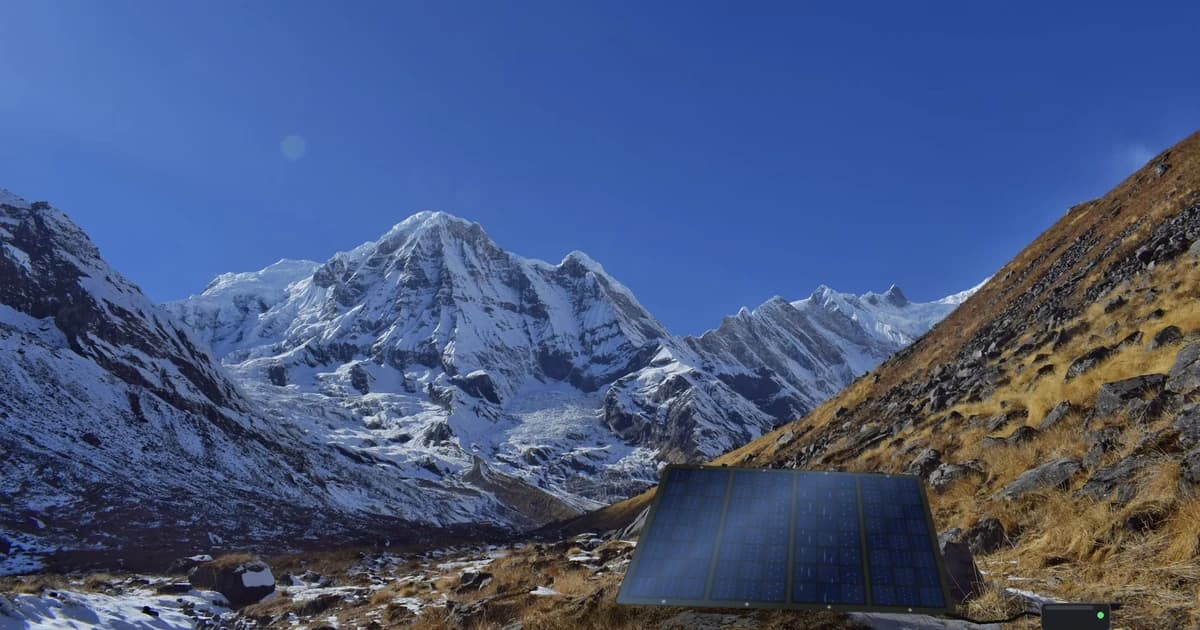
Portable solar panels on ABC Trek can be helpful for trekkers requiring a different method to recharge their electronics in the mountains. On the Annapurna Base Camp Trek, they can assist with low batteries, but they're not a substitute for teahouse charging.
The biggest issue is whether the portable solar panel can create sufficient energy consistently throughout the trek.
A compact portable panel is ideal for keeping a power bank charged on sunny days. But it can be challenging to depend on solar energy 100% during cloudy weather or when it rains.
For the majority of trekking, it's better to think of a portable solar panel as a backup power source, rather than use it as a standalone energy source.
How Do Portable Solar Panels Work on the ABC Trek?
A portable solar panel is a solar energy device that is designed to capture sunlight and convert it into electricity to power an electronic device.
The most efficient trekking configuration is typically:
Solar panel → power bank → phone or other device
It's easier than attempting to charge the phone from the panel. The sun changes throughout the day and clouds can reduce the amount of power generated.
A buffering effect is created with a power bank. The panel can be in a better location to receive sunlight with the power bank storing energy. Then charge your phone from the power bank as per requirement.
The panel can gather the sun's energy while you're resting or when you're staying in a sunny spot.
But solar panels don't produce the same amount of electric power all day long. Performance varies with intensity and angle of the sun.
Is Solar Charging possible on Annapurna Base Camp Trek?
The ABC route passes through different elevations and landscapes which can affect the amount of sunlight available. Consequently, these can shift significantly in the amount of available sunlight throughout the way.
Open areas with direct sunlight provide better conditions for solar charging. Trees can block sunlight, while clouds can further reduce the panel’s ability to generate power.

Portable solar panels that can be used during a trek
This can result in the solar panel not charging each day as optimally as it could.
A solar panel can generate a significant amount of electricity on a sunny day, but much less when it's overcast. Even if the sun is visible, it means that the panel must be directed correctly to get good direct sunlight.
Solar panels can carefully increase electricity to your battery when appropriate solar light is present.
What Affects Solar Panel Performance on the ABC Trek?
There are multiple factors that affect the amount of electricity a portable solar panel will generate.
Sunlight intensity
One of the most critical factors affecting solar cells is direct sunlight. Generally, a panel placed in heavy sunlight will generate more electricity than will a panel placed under a cloud or in shade.
The exposure to direct sunlight varies during the day on the trek to ABC. Some parts of the forest may allow for some exposure, and open spaces may allow for more exposure.
Therefore, it is important because having a solar cell on your backpack doesn't mean it will charge efficiently. Position and exposure are important.
Weather conditions
Solar charging is greatly affected by the weather.
Cloudy weather decreases the amount of sunlight that reaches the panel. The downside of outdoor charging is that bad weather in the form of rain makes solar charging unfeasible, and snow and clouds cut into solar charging efficiency.
This is critical in planning for trekking in times of more unpredictable weather. This means that it's best to use a solar panel as a backup or additional power source, not one that you have to rely on daily.
Shade
The performance of solar power panels can be seriously diminished with shade.
The ABC trail route crosses through areas containing trees, cliffs, buildings, and other natural or man-made obstacles. A few minutes of sunlight may offer more effective charging time than longer times in the shade.
If you need to take a break, find a place in the direct sun in an open area. Even 10 minutes of good sunlight is more productive than having it installed in a covered area for a very long time.
Panel positioning
The direction of the panels toward the sun can also be important. If a panel is on a backpack and is flat, or is not facing the sun, then it will not get as much sunlight as if it is facing it. If possible, move it at break time to optimize the light source.
Do not watch the panel at all times, but it may be helpful to keep it clear and clear of shadows and point it towards higher sun angles for better performance.
Temperature and environment
Batteries and charging equipment may be impacted by cold mountain conditions. Solar panels are capable of producing energy even when the weather is cold, provided that sunshine strikes, but the battery or power bank that stores this power should be kept out of extreme cold temperatures.
Sheltering the power bank adequately and ensuring it does not stay much longer out in cold places can help keep it performing.
Where Can You Use a Solar Panel on the ABC Trek?
The best place to use a portable solar panel is wherever you have strong, unobstructed sunlight.
Lightweight folding panels are strapped to the backpacks of some trekkers during walking hours. This means there's no need for a separate stop for each charge.
Backpack charging, though, isn't always ideal. You might walk in different directions across the panel or be shaded by your body, and some of the panel might be under trees during parts of the day.
Sometimes the panel can be used during breaks, which may offer better control. It can be set in direct sunlight and can be moved as needed.

A trekker facing the mountains at ABC
ABC Trek teahouse areas can also have appropriate outdoor places where a solar panel can be installed. The conditions, however, are not consistent, and don't take it for granted that every teahouse will have an ideal place to take advantage of sunshine for solar charging.
Weather and surrounding mountains may influence performance, but in more developed areas, open scenery may be present, allowing good exposure to sunlight at higher elevations.
How Long Does a Portable Solar Panel Take to Charge?
The charging time at Annapurna Base Camp Trek depends upon the solar panel types and sizes.
The watts indicated by the manufacturer are the maximum output of the panel under optimum conditions. Actual generation may be less due to cloud cover, panel orientation, temperature, shade, and charging losses.
For instance, a 20W panel is not going to produce 20W over an all-day trek.
It can take many hours of good lighting conditions before a small panel will contribute a worthwhile amount of power to the power bank. The same panel can make much less under cloudy weather.
That is why one should consider thinking of solar charging as a slow and gradual process of power generation and not as a substitute for a wall charger.
Should You Charge Your Phone Directly From a Solar Panel?
The alternative solution for most trekkers is to charge the power bank first and then use it to power their device.
However, the biggest issue with direct charging is the variability of the sun's ability to generate energy from day to day.
The power available can change if a cloud moves across the sun or the position of the solar panel changes. This can prevent or slow down the charging, or make it inefficient.
Use the solar panel to charge the power bank when the conditions are right and provide power to the phone from the power bank.
This setup allows greater flexibility, as the stored power can be utilized when sun is not available.
Verify the compatibility of the solar panel, cables, and power bank before using to make sure your devices can run on power from the solar panel. Do not assume all panels will function with all devices; follow the manufacturer's instructions.
What Size Solar Panel Do You Need for the ABC Trek?
The right size of the panel depends on the power requirement.
Small solar panels
Small lightweight panels are better for backpacks, but have a smaller charge capacity. Their crucial benefit is certainly minimal weight. The drawbacks of these are that they have less charging space.
20W to 21W panels
For trekking enthusiasts with multiple small electronic devices, a 20W panel may provide a practical compromise between portability and capacity.
It can be useful for slowly yet steadily charging a power bank while the sun is good, but without the weight of a much larger panel.
28W or greater
The bigger the panel, the more power it can supply; however, it also can add a bit of weight to your pack.
Depending upon the number of devices that use a lot of power, they make sense for trekkers, but they might not be the best choice for someone who is only bringing his or her smartphone.
Most ABC trekkers want to find a reasonable compromise between load weight versus size, charging capacity versus shock, and power requirements.
Portable Solar Panel vs. Power Bank for ABC
Solar panels and power banks are distinct things.
A power bank provides power storage to draw power when the sun is not available and a solar panel will provide power when the sun is available.
When appropriate solar light is available, electricity is produced by the solar panel. It offers a means for the device to regenerate its stored charge while not charging from an external source.
Both can be used together for flexibility in charging.

A portable power bank and charging cable
If you only have a power bank, all your energy is on its level; unfortunately, you can only gather as much energy as it can hold and have the chance to fill it up only as many times as you have.
You can get just a solar panel, but this makes it too weather- and sun-sensitive for a reliable charging solution.
For many trekkers, an electric power bank should be the first option for backup energy, and a solar panel could be used if weather permits.
Is a Solar Panel Worth Carrying on the ABC Trek?
The value of carrying a solar panel is all personal and dependent on the particular power requirements.
If you can only see smartphones and have frequent access to teahouses and the ability to charge while there, a solar panel might not be needed. The extra weight might not be beneficial for a shorter hike.
It's more beneficial if you are bringing a number of electronic devices or if you want to be more self-sufficient in the absence of outlet spaces.

View of Mt Fishtail from ABC
Solar charging can be of benefit to any photographer who finds that their camera and other gear can eat up more energy. The same goes for trekkers who're backpacking several navigation/ communication/ or documentation gadgets.
How long you're on your hike can also make a difference. The longer the trek, the more opportunities to get benefits from using a solar panel without relying on charging facilities.
But on a longer hike, the weather is even a constraining factor for solar generation. A power bank as stored backup is still a must-have.
How to Use a Solar Panel More Effectively
With some easy tips and tricks, solar charging can come in handy on the ABC trek.
Allow the panel to be in direct sunlight. Do not put it under trees or in your backpack behind other objects.
Carefully put the panel into place. If you do get a break, turn it towards the brighter sunlight, instead of placing it flat in the wrong direction.
Fill your power bank before charging your device. This allows you to keep stored electricity for use in the future when the sunlight is not present.
Start charging early. Never look for the sun when your power bank reaches 0%. Ramping power up over the course of a day is more feasible.
Don't let the power bank get too cold. The panel can be left in the sun whilst the battery is stored in a more secure area.
Ensure that the panel surface is clean. Sun protection can be compromised if dust, dirt, or something else sticks to its surface.
Avoid using solar power as the sole source of energy. Be equipped with sufficient stored electricity for rainy days or during a rain period.
Common Mistakes When Using Solar Panels on the ABC Trek
People make several mistakes, one of which is assuming a portable solar panel is similar to a wall charger.
The charge rate of solar charging is not as fast as conventional charging, and it is more affected by the environment.
Using wattage only to select a panel may result in unrealistic expectations. In the case of trekking, higher-wattage panels are not necessarily more advantageous. Equally important are the weight, size, and portability, as well as your electricity usage.
Some trekkers even put their panel in the shade while they are hoping to charge efficiently. Good results can be achieved with direct sunlight.
Another error is the choice not to provide a storage solution or pair to the solar panel. If the panel is generating energy when one is walking and needs to store it but is unable to because of a lack of a convenient receptacle, then some of the power of the panel is lost.
Lastly, don't solely rely on solar energy sources for backup. Weather in the mountains can vary rapidly, and there may be days when solar charging doesn't work as well as is hoped.
Is Solar Charging Reliable in Different Weather?
Clear and sunny weather is best for solar charging.
The performance of the panel may vary under partly cloudy conditions, but it will generate some power. During heavy clouds or rain, the charging may become significantly slower.
This distinction makes a difference on the ABC trek, as conditions can vary with the change in altitude.
So, the user of a trekker should expect solar charging as an extra source of electricity, not a daily electricity source.
Keep a reasonable reserve power if necessary to navigate and communicate with the devices, and to take photos or in emergency situations.
Who Should Carry a Solar Panel on the ABC Trek?
When using a portable solar panel, you might find it convenient to:
People with several electronic devices used in trekking
Photographers using batteries for their cameras. Photographers using batteries on their cameras.
Mobile phone and camera users regularly
Those who are trekking longer days on the ABC
Individuals who prefer to be less dependent on teahouse charging
Back-up charging for trekkers who need it
It is not as useful to someone with just a phone, particularly if the trip is not as long and charging is readily available.
Ultimately, it will depend on your gear, the length of your trek, and what you're comfortable with in terms of weight distribution.
Final Thoughts
Portable solar panels can be used on ABC Trek, but effectiveness will be dependent upon weather, positioning of panels, size of panels and power requirements needed.
They should not be considered a replacement for regular charging facilities. A solar panel along with a power bank can create a more reliable charging system.
For trekkers carrying multiple devices, a solar panel can be a useful additional charging option.
A portable solar panel might be beneficial for extra charging. A solar panel is a good piece of gear on this trek, provided one has realistic expectations about it, combined with the necessary gear.