

Annapurna Circuit will not break you on climbs. It will break you down to basics. On top of Thorong La Pass at 5,416 meters (17,769 feet), your body is running out of steam, burning more calories than you are able to consume and losing fluids with each breath.
What you consume on this trail every day is more important than most people think. Over 12-15 days, what you will eat will define how your legs feel climbing a mountain, how you will sleep at altitude, and if you will have enough energy to meet the challenge the following day.
Good news: between Besisahar and Jomsom, teahouses offer decent food. You will eat better at altitude than you thought you would.
Here is a complete guide on Annapurna Circuit Trek food, telling you what to eat at all meals, what local food to try, how to get enough water at extreme altitude, snacks that will do you good, how much things will cost, and the best advice of guides who have made this route dozens of times.
Annapurna Circuit Trek Food Options
All of the teahouse menus within the Circuit operate according to a similar template. The teahouses offer laminated menus with Nepali cuisine as well as pasta, soup, and fried rice. The size of menus decreases and prices increase as one travels north from Manang into Thorong La.
The cuisine is influenced by the culture of the particular community you have been walking through. You encounter the lower altitude Gurung communities before the higher altitude Thakali and Manangba communities.
Every community has a unique set of foods and most of the teahouses offer food that has been inspired by their cuisine.
This is how your days will pan out when trekking around the Annapurna region.
Breakfast Options on the Annapurna Circuit Trek
A hearty breakfast on the Annapurna Circuit cannot be avoided. In most cases, you begin your trek early in the morning and your muscles require slow-burning energy to keep going all day.
Tsampa porridge, which is roasted barley flour, is one of the foods that trekkers can eat for breakfast.
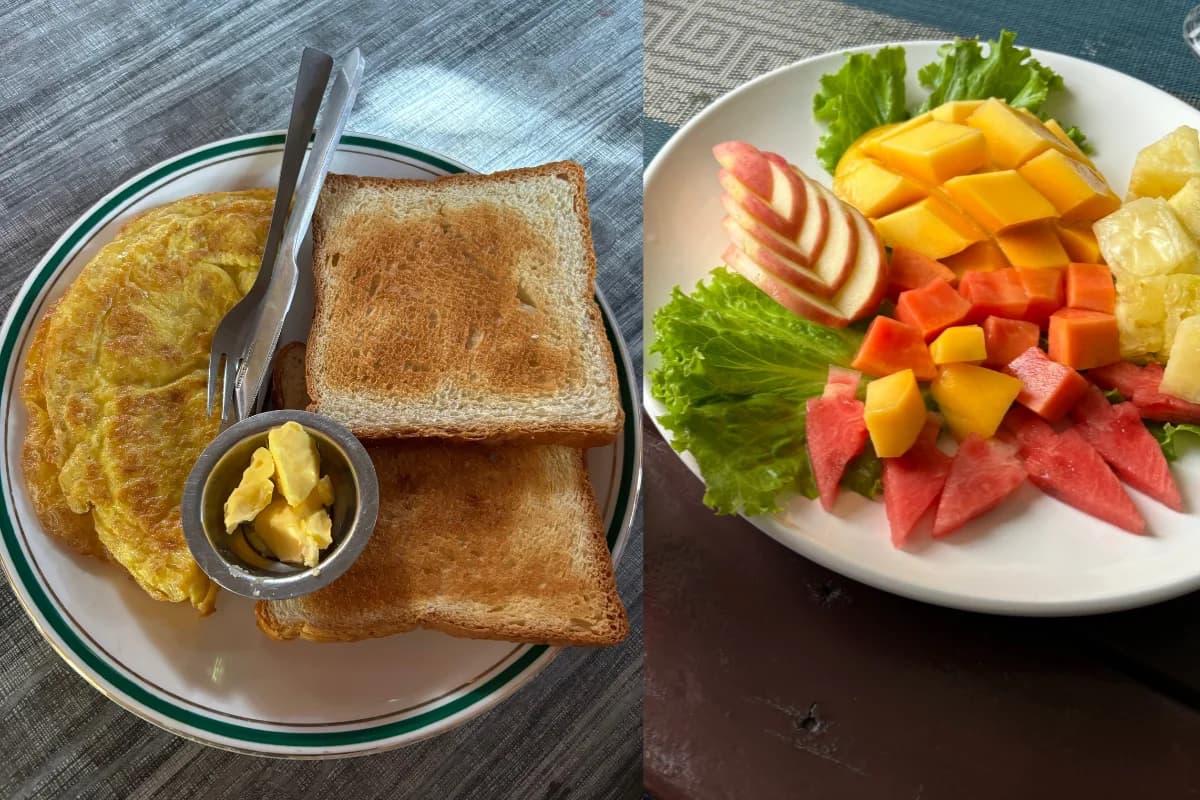
Other foods include Tibetan bread with butter, honey, or jam. The eggs can be eaten as fried, scrambled, or as an omelet with toast. Trekkers can also opt for muesli or oats with the local milk or hot water. Banana pancakes are common in teahouses and can be found anywhere. Chapati with peanut butter and black tea can also be considered for breakfast.

Annapurna Circuit Trek breakfast
The vegan trekkers can consume tsampa with water. The banana pancakes should only be eaten after confirming that there is no use of any egg or dairy in them.
Toast with jam or peanut butter is another good option. The gluten-free trekkers should eat rice porridge, boiled potatoes, corn porridge, and egg dishes without toast.
It is advisable to consider one fact; teahouse kitchens are small and communal. The danger of contamination can occur. You have to approach the cook for all your requirements concerning your diet.
Lunch Options on the Annapurna Circuit
Most trekkers take a lunch break in the middle of their trekking route, 3 to 5 hours into the trip. Try to get something that fills you up but not something too heavy as you have more trekking time ahead of you.
Dal Bhat is the best lunch choice. It is made up of rice, lentil soup, vegetable curry, and a pickle. Fried rice and fried noodles come with vegetable, egg, or mixed choices. Thukpa is Tibetan noodle soup that is warm and very light for your stomach.
Potato wedges or garlic soup can be chosen as light meals. Spring rolls and vegetable soup are good quick lunches. Momos are steamed dumplings that are available until Manang.
If you are vegetarian, ask for Dal Bhat without ghee. Vegetable thukpa and vegetable fried rice are okay to eat. Gluten-free meals include Dal Bhat, plain fried rice, and boiled potatoes. All savory meals in Nepal are naturally dairy free.
Dal Bhat is the recommended lunch by the guide. It comes with unlimited refills in most teahouses. This meal is well balanced nutritionally and is also the cheapest among other hot meals on the menu.
Dinner Options on the Annapurna Circuit
For the dinner after a long day of trekking or the Thorong La pass, recovery is what counts, rather than diversity and variety. Warmth, carbohydrates, and easy digestibility become priorities over anything else.
Dal Bhat will never be boring; besides, you require those carbohydrates in your body. Pasta is found in almost all teahouses starting from Manang on.

A hot bowl of Thukpa
Garlic soup is a favorite dish at altitude. It is believed to help with the acclimatization process, although scientifically, there is no proof of that. It is warm, hydrating, and easy to consume when your appetite becomes poor.
Dal Bhat is the only meal you should have starting from the altitude of 3,000 meters (9,842 feet) and above for lunch and dinner. The appetite decreases with the increase of Annapurna Circuit Trek altitude, but you still require food.
Vegetarian and Vegan Food on the Annapurna Trek
Nepal is another great destination where trekking can be done in combination with a vegetarian diet. Vegetarianism is an integral part of the country's history; plant-based food was used here long before becoming popular around the world.
In Hindu and Buddhist cultures, people follow a philosophy of nonviolence toward all living beings, which contributes to the availability of vegan foods, particularly in local teahouses located on the trekking route.
Various vegetarian foods can be found everywhere along the route. Dal, vegetable curry, and potato dishes will always be on the list.
But then there are some hidden dairy pitfalls. Dal Bhat's vegetable curry dish is often prepared using some ghee on top. While the dal itself should be okay, it’s still better to inquire. Porridge and tsampa often have some milk powder in them.
Chapati and roti can be covered with butter at the end of preparation. Fried rice is often made with eggs, which isn’t always noted as an ingredient. There are many varieties of momos and the veggie variety is always vegan.
They are stuffed with cabbage, onion and ginger. Potato and noodle soups are usually okay, but inquire if any butter has been used. Chai is always made with milk. Ask for kalo chiya that means black tea or bring your own plant milk packets.
Since you will be trekking to higher altitude levels, meat will become harder to find. Proper refrigeration and delivery of food supplies are very hard to organize. Teahouses will make dishes out of local vegetables, lentils and grains. It’s difficult to rear livestock in such harsh conditions. Meat transportation from lower altitudes is too costly. Meat will be considered a luxury in the mountains.
If you’re vegan and climbing high up, then take plant protein powders. Plant proteins derived from rice, peas, or hemp can be mixed with hot water and are light to carry. Take enough to provide you with at least one portion a day.
Nut butter packs, dark chocolate, and a variety of nuts will serve well as they are calorie-dense and lightweight.
Dal Bhat: The Trekker's Staple
Then there's a saying every Nepalese repeats: "Dal Bhat Power 24 Hour." And after you've spent a couple of days hiking the trails, you will definitely know why.
Dal Bhat is the national dish of Nepal and the most essential item of food that you need to have during your trek here. It consists of steamed rice, lentil soup, vegetable curry, some salad, and pickles. Simple, but perfect after a six-hour hike.

Nepali dal bhat, which can be eaten as dinner or lunch
It is recommended by all experienced trekkers for a reason. Besides being tasty, it provides your body with the necessary nutrients. It is carb-rich with a sufficient amount of protein thanks to the lentils. Also, in most teahouses, Dal Bhat is served free of additional charge.
In areas below 3,000 meters (9,842 feet), it costs about USD 5 to 6 per plate. Higher up in Manang and Thorong Phedi, it goes up to USD 8 to 10. However, it remains the most profitable choice on the menu regardless of the altitude.
In nearly all tea houses, Dal Bhat is served unlimited times at the same price. The guides and porters take it twice a day. This meal is the most nutritious and contains the highest number of calories compared to other hot meals.
You will find Dal Bhat much healthier than pizzas ordered by trekkers who do not take Dal Bhat for dinner every night after Manang.
Meat and Egg Availability
Availability of meat varies greatly depending on the altitude. Chicken, buffalo meat and sometimes pork are available in lower villages such as Besisahar, Jagat, and Dharapani. Egg dishes can be found in almost all teahouses.
When you go higher than Manang, you will not see much meat in the menu of the teahouses. They cannot keep meat under refrigeration. Meat does not come there. Be careful if you see meat above 3,500 meters (11,482 ft). The meat could be carried up there and kept without refrigeration.
Egg dishes are more reliable. They are available in most of the teahouses. Eggs provide protein. Fried or boiled eggs will make you feel happy if you get tired of eating Dal Bhat.
Yak steak is the specialty of Manang. Yak meat is locally produced and for many people it is the best dish at the Circuit. Yak steak costs USD 8 to 12. If you eat meat then you must try this locally produced fresh meat.
Snacks and Energy Drinks for the Trail
Snacks help you stay on the go from one meal to another. Snacks help you feel motivated during difficult times on the trail. Hot beverages will help you stay warm and hydrated.
Snacks and Energy Foods for the Trail
You will find snacks at teahouses and shops along the route. However, options and prices diminish as you ascend. It's best to carry your own snacks from Kathmandu or Pokhara since it can save you some money.
Good trail snacks are energy bars, nuts, dried fruits, chocolate bars, and biscuits. You can find all those items in lower villages, although the prices get high as you ascend. Instant noodles are available everywhere; they are cheap and fast. Popcorn is a light salty snack that can be found in most teahouses.
Among local specialties, you should try apple pie in Marpha village; it's made from local apples and costs around USD 3 to 4. Yak cheese is a great snack that can be found in Manang.
Taking a few snacks from the villages at a lower level takes care of their daily expenses. Snacks such as biscuits, popcorn, and instant noodles cost NPR 150 to 400 (US$ 1.50 to 3.50), while chocolate bars and energy bars cost NPR 300 to 600 (US$ 2.50 to 5).
Tea, Coffee, and Hot Drinks on the Annapurna Circuit
Hot beverages are a common feature during the morning time in the Annapurna Circuit trekking. Some of the hot beverages one may have include milk tea, black tea, coffee, and hot lemon.
Tea or hot lemon will cost between NPR 100 and NPR 300 (USD 1-2.50). Coffee or hot chocolate costs NPR 200 to 400 (USD 1.50-3.50)
The cost of black tea increases with altitude. One can get a cup of black tea for NPR 100 at Chame and NPR 200 at Thorong High Camp.
For budget trekking, one can carry their own tea bag and herbal teas. Request for hot water; it will be cheaper than buying tea. This is a small trick that saves you money in the two weeks.
Ginger tea is also common and it is warm and soothing. It also helps with digestion and altitude sickness. Garlic soup is a common high-altitude beverage because it is warming and hydrating.
Annapurna Circuit Food Cost and How It Rises with Altitude
The cost of food on the Annapurna Circuit increases progressively with elevation. As the height of the halt increases, so does the price of everything.
While a dish of Dal Bhat which costs NPR 700 in Besisahar will cost you NPR 1,300 in Manang, you'll pay NPR 1,500 for it around the area of Thorong High Camp.

Local Nepali momo
If you buy one cup of black tea for NPR 100 in Chame, you'll pay NPR 200 for it in Thorong High Camp. A plate of Dal Bhat will cost NPR 800 in Chame and NPR 1,200 in Thorong High Camp.
Above the altitude of Manang (3,540 meters/11,614 feet), prepare yourself to pay about 30%-50% more for the same commodities.
Here's a breakdown of typical prices:
Dal Bhat: NPR 700 to 1,200 (USD 5 to 9)
Breakfast Set: NPR 850 to 1,400 (USD 6 to 10)
Thukpa / Thenthuk: NPR 600 to 1,350 (USD 4.50 to 10)
Pizza: NPR 650 to 1,600 (USD 5 to 12)
Momo (steamed or fried): NPR 550 to 850 (USD 4 to 6)
Soup: NPR 350 to 800 (USD 2.50 to 6)
Beer: NPR 700 to 1,200 (USD 5 to 9)
Black Tea: NPR 100 to 200 (USD 0.75 to 1.50)
Coffee: NPR 150 to 260 (USD 1 to 2)
Daily food budget (lower circuit): NPR 2,000 to 3,000 (USD 15 to 22)
Daily food budget (Manang and above): NPR 3,500 to 5,000 (USD 26 to 37)
Food and beverage allowance would be USD 30 to 40 per person per day. The price will be relatively lower at lower elevations and gradually increases with elevation.
One golden rule when visiting tea houses at high elevation: have meals where you sleep, or else the room fee would double.
That is the general policy; they have low room rates and earn from food. They do not earn from the room fee but from what people consume inside the tea house, and that is why they double the room fee if you eat elsewhere.
For Thorong High Camp, order your breakfast the previous evening and settle your bills before sleeping.
Drinking Water on the Annapurna Circuit
Hydration is essential when trekking at altitude. However, carrying water along the Annapurna Circuit demands preparation.
Water can be accessed by buying bottled water from teahouses and stores along the trail. However, it is costly and environmentally unsound. Purchasing water is priced between NPR 150 to 500 per bottle depending on the popular route taken. Cost increases with altitude.
You will consume and dispose of about two million bottles of plastic water along the trails in Nepal annually. If these bottles were laid down in a line, they would cover the distance between Kathmandu and Everest Base Camp and return over seven times.
Refilling stations remain the best way forward. There are 20+ refill stations along popular Everest and Annapurna routes. The cost of using a refill station is NPR 60 to 100 per liter.
Safe drinking water facilities have been developed in 29 locations in the Annapurna area through the Annapurna Conservation Area Project.
The hotel operators get their drinking water at the most subsidized rates possible. Tourists have an opportunity to fill their water bottles from those sources rather than to buy new bottles.
Water refill stations managed by the community sell treated water on several popular trails. The cost of water is paid by the liter. Make sure you inquire about the way it is treated. Have your purification method as a backup anyway.
Some of the trekkers claim that safe water sources were not functioning in 2016 but now operate again. Different things happen in different places. Do not depend on refill stations only. Have your own purification method with you always.
Water Purification Methods and Daily Water Needs
Water sources on Nepal's trekking trails must be boiled, treated chemically, UV-treated, or filtered and subsequently treated.
Appearing clear does not mean safe for consumption. All water in the trails goes through villages, lodges, and livestock before reaching you. There will be people or animals somewhere upstream in almost all streams you come across. Clean-looking water can also contain bacteria, viruses, and parasites.
The most suitable treatment method for most trekkers is a combination of two methods. Always have a chemical purifier, for instance, Aquamira or Aquatabs. Boil the water from teahouses. If you desire rapid processing or improved taste, include SteriPEN or Sawyer filters.
A single filter is insufficient in Nepal. The majority of filters used in trekking, like Sawyer Squeeze, cannot filter out viruses.
Boiling is dependable regardless of the altitude. You should boil water until it starts bubbling vigorously for 1 minute in low elevations or 3 minutes beyond 2,000 meters (6,562 feet).
Treatments such as iodine and chlorine dioxide are effective. Be sure to follow instructions carefully. Do not consume the water before the indicated time frame elapses. The purpose is to inactivate cysts which are more resistant.
Cold is the genuine destroyer of gears. Carry your filters and UV light sticks inside your jacket during daytime and in your sleeping bag at nighttime. Batteries run out of charge; filters freeze, and filling stations close down.
What amount of water do you require? You need to take between 3 and 4 liters of water daily. If you sweat a lot, then you need more water. Dehydration may mimic altitude sickness.
Food and Water Safety Tips for the Annapurna Trek
It is usually a series of minor errors that make most trekkers fall sick, rather than one major mistake such as drinking directly from the stream. A toothbrush used without being properly disinfected under running water. A bottle refilled without giving enough disinfection time. Dirty hands after lunch with trekking poles, cash, and the teahouse cat.
Here are practical tips to stay healthy:
Wash your hands frequently. Always carry hand sanitizer and apply it before meals. It can be stored in your hip belt pocket.
Use boiled and filtered water to brush your teeth. Ensure that no water gets into your mouth while bathing.
Do not trust salads. Particularly during the rainy season. There are instances where some restaurants may be washing salad greens using lightly iodized water, but then you cannot be certain.
Rinse all your fruits and veggies properly. Rinse them with boiled and filtered water. Also consider peeling them.
Try looking for freshly prepared food. Avoid any food that has been cooked and stored without refrigeration. Flies spread disease organisms.
Eat Dal Bhat when trekking at high altitudes. This is fresh and easy to digest.
Always drink tea that has been made using boiling water. This is made by pouring boiling water on tea dust directly into your glass. Chances of having survived disease-causing organisms in this case are minimal.
Always carry oral rehydration salts in case you get diarrhea because hydration becomes very important.
Always carry a basic first aid kit. Carry with you medications like Imodium.
Plan Your Annapurna Circuit Trek With Us
Are you going for an Annapurna Circuit Trek in 2026? Drop us a line on WhatsApp at +977-9851042334, and we can surely arrange your trek depending on your time, choices, and fitness levels.
Conclusion
Food in the Annapurna Circuit is more than fuel. Food is part of the adventure. You will eat Dal Bhat alongside the porters that have done the circuit many times before.
You will also enjoy yak steak in Manang and apple pie in Marpha. You will enjoy ginger tea in the dining hall of a teahouse amidst snow falling around.
However, food and hydration play a practical role. What you eat influences your health and comfort at high altitudes. Hydration determines your ability to cross the Thorong La Pass. How you purify your water determines whether you spend your time in teahouse toilets or on the trails.
Eating Dal Bhat when at altitude is important. You should consume 3 to 4 liters of water daily. Use two means of purifying your water. You should eat where you sleep. Pack snacks in lower altitudes. Order breakfast the previous night when going over the pass.
The Annapurna Circuit will push your body to the limits. However, eating and drinking will help your body through. The mountains will be waiting for you.