Bisket Jatra stands as one of Nepal’s most dynamic traditional festivals. Moreover, Bhaktapur residents observe with exceptional fervor. The celebration of Bisket Jatra is a New Year festival on Nepal's Sambat calendar. It displays Nepal’s traditional heritage. It is a combination of religious events, mythological elements, and social competitions.
Wars between different towns from the Malla period have highlighted the festival. It continues to the present day as part of Nepal's cultural legacy. The festival expands into Thimi and Bode. Here, locals take part in their distinct Bisket Jatra ceremonies.
Bisket Jatra's Significance in Nepal
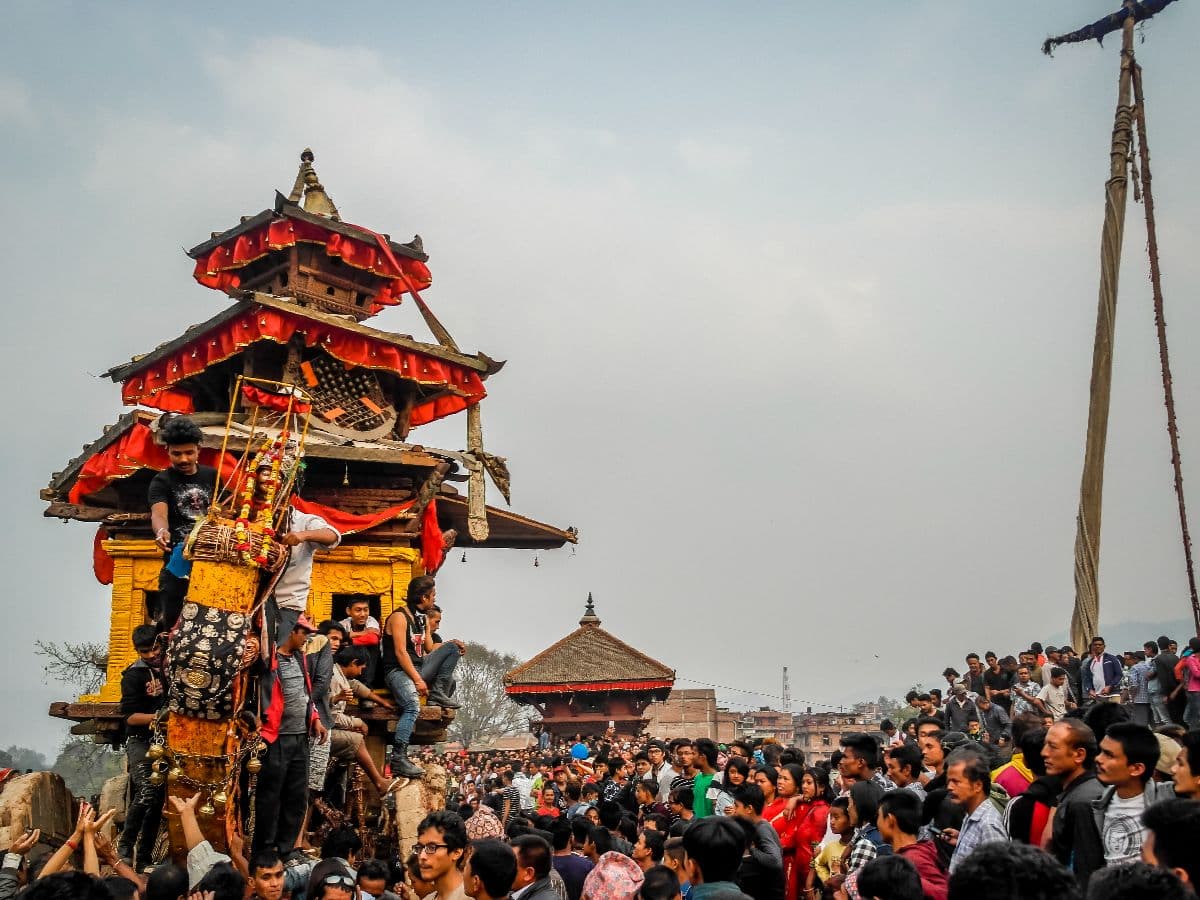
Lord Bhairab and Goddess Bhadrakali stand as the central deities in Bisket Jatra. They hold significant religious status in Hinduism, especially among the Newar community. The high-energy tug-of-war competitions are held in Bhaktapur. It revolves around massive, intricate wooden chariots. It surpasses the city streets in height.
 Taumadhi Square becomes the epicenter for this significant event. It demonstrates divine opposition through physical power while simultaneously retaining its sacred meaning. The team that achieves victory exercises control over the chariot movement. People in the surrounding area feel enthusiastic and expect what will happen next.
A central religious tradition during this festival. It involves constructing and ultimately destroying a massive lingo (wooden pole) at Lyasinkhel. It signifies the start of the New Year. People together raise the pole. The pole reaches heights of more than 20 meters during these celebrations. It embodies divine power as well as masculine traits and fertility.
Throughout the festival's final days, the lingo receives a special ceremony. Its collapse marks the arrival of the new year precisely. Nepalese view this ceremony as a significant spiritual sign for the following year. It mirrors indigenous spiritual customs and Hindu cosmological beliefs.
How is Bisket Jatra celebrated?
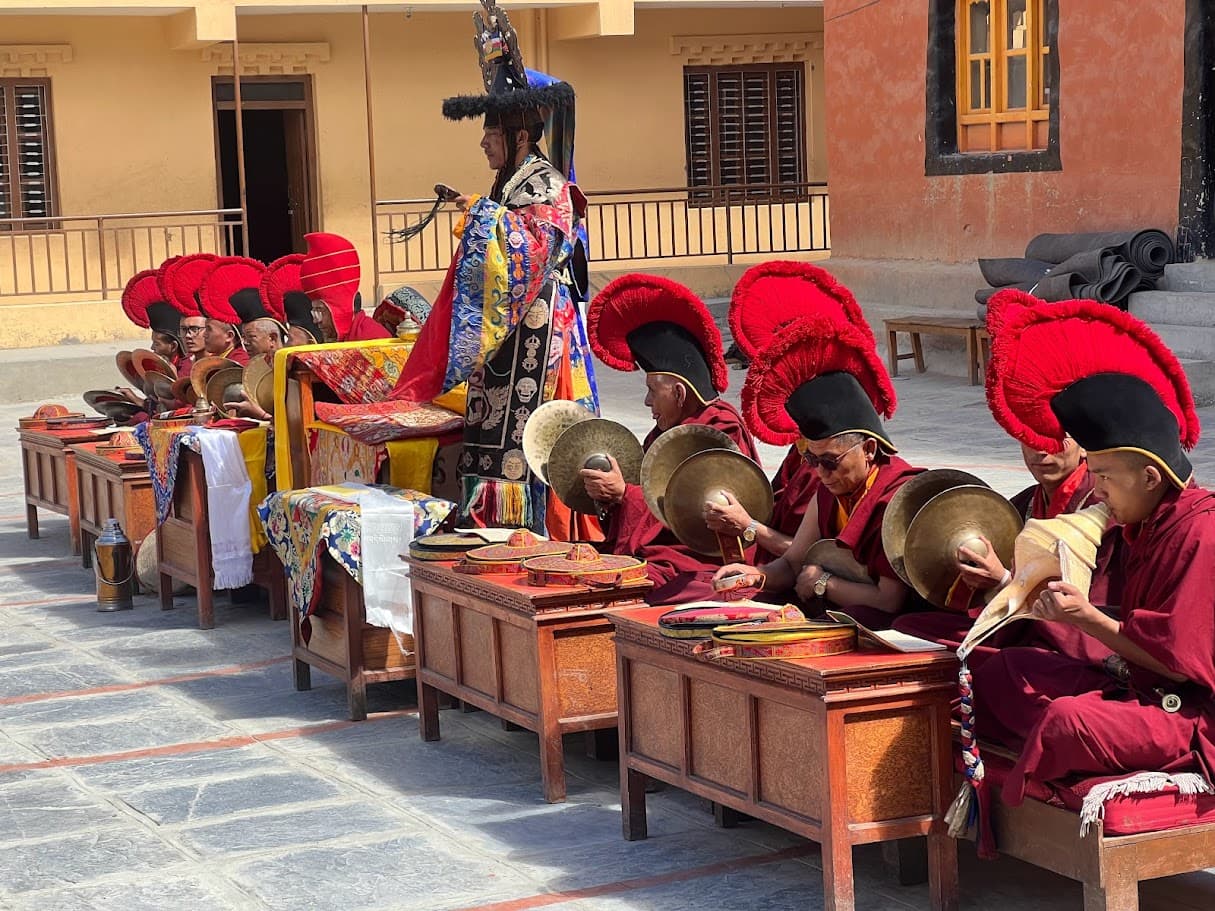
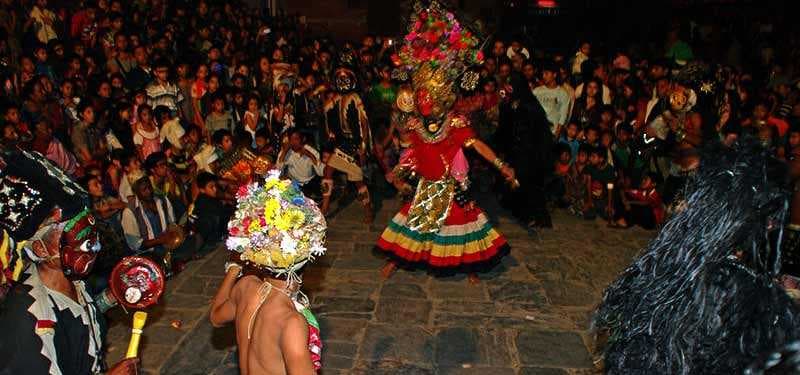
Bisket Jatra creates an environment where religious reverence meets excitement. Moreover, unity forms among people through communal relationships. Traditional Newar music accompanies masked dancers. They carry out sacred rituals as families create feasts. Together, create an immersive cultural event.

Visitors from Nepal and foreign countries gather to see the spectacular display. The vendors, along with artisans, display their magnificent work throughout the streets. Through this celebration, Nepal maintains its ancient heritage. It makes it a fundamental tool to connect people across generations. It also provides a glimpse of their traditional heritage.
It's best for those who want to experience the authentic spiritual atmosphere. It offers social customs of the Newar culture in Nepal. Attend Bisket Jatra for a transformative cultural exploration. Travelers immerse themselves in a vibrant heritage through watching the chariot processions. Or taking part in Sindoor Jatra and viewing the risky tongue-piercing ceremonies. It is an experience, a tradition that maintains its authenticity.
Bisket Jatra exists as an extraordinary event. People can explore significant moments from Nepal's historical past. You experience religious convictions and traditional practices.
The origin of Bisket Jatra
Bisket Jatra celebrates and maintains connections to the historical Newar civilization. It is also crucial to the history of the Malla period, originating in Kathmandu Valley. The Malla kings from Bhaktapur created Bisket Jatra to establish religious unity. It was also for social connections of he local population. The date fell on the Nepali New Year according to the Nepal Sambat calendar.

Through time, Bisket Jatra transformed into an extensive event. It unites Hindu principles with Newar traditions to mark victory against evil. It also brings renewal and welcomes new prosperity.
Historians believe Bisket Jatra has roots in a legend about a princess. It is about a princess who could not find love. Every male visitor who joined her in bed perished before sunrise. The king faced desperation. But then found an answer when a bold individual pledged to marry the princess. He later uncovered what was hidden.
Legend behind the Bisket Jatra
Ancient folklore shows that Bisket Jatra stems from a legend in ancient Bhaktapur. It tells a story about a cursed princess. The princess resided here, whose marriage brought tragedy. The princess's suitor faced a sudden death by the next morning. In this tale of the princess, a youthful hero received warnings about the danger. As such, the hero remained vigilant through the nighttime. Here’s how the story goes:
The king attempted to solve the problem. But many potential suitors met their tragic end at the hands of the curse. It left the kingdom to suffer in despair. No one knew where this fatal curse originated. But the entire kingdom remained in desperate need to discover how it could be broken.
An intelligent young man made a courageous offer to wed the princess.

The youth yearned to solve the fatal curse that claimed the lives of men after marriage ceremonies. During the night, he continued to stay awake rather than letting sleep overcome him. The former suitors had all slept.
At midnight, the young man watched two massive serpents emerge. These venomous creatures came from the princess’s nostrils as she rested asleep. After noticing the snakes as the source of past fatalities, he retrieved his sword. The youth destroyed the snakes, thus ending the curse.
The morning hours of the princess's husband survived. The completion of the dangerous period became the cause for kingdom-wide celebration. The residents of Bhaktapur established Bisket Jatra to honor the historical event. They performed rituals that include ceremonies featuring snake symbolism.
Quick action from him destroyed the deadly serpents, which broke the cycle of death. The myth is reenacted symbolically throughout different activities during Bisket Jatra. It is to emphasize its native culture and victorious spirit against evil dangers.
Uniqueness of Bisket Jatra in Thimi and Bode
The Nepali festival displays different forms in Bhaktapur. The festival offers unique customs in Thimi and Bode. This enriches the Bisket Jatra celebrations. Sindoor Jatra in Thimi. It is celebrated by throwing bright red and orange colored powder at each other. They carry religious statues during a procession through the town streets.

Bode residents conduct a sacred ritual that involves a person willingly piercing their tongue. They pierce it with a metal skewer. After this, he walks through the town to exhibit devotion and spiritual ability.
King Jitamitra Malla's Blueprint of Bisket Jatra
Historical records say that the Malla kings established Bisket Jatra. They supported religion and cultural events. King Jitamitra Malla (1673–1696 AD) established the format for the celebration. He united many rituals with chariot parades, along with public participatory elements.
The Malla dynasty established the grand Bhairab and Bhadrakali chariot procession. It combines their religious Hindu devotion with subject loyalty. Through his dedication, the king established Bisket Jatra as a regular annual celebration. It deeply penetrated Bhaktapur's spiritual and social domains.

The Newar words "Bi" and "Syaku" compose the origin of the word "Bisket." It points to the mythological killing of snakes. The festival name originates from the notion that it marks the start of yearly renewal. Furthermore, with the transition between the present and the future.
The festival maintains its symbolic message of divine power and cosmic equilibrium. The traditional wooden pole rituals begin with its elevation, followed by its collapse. People perform the intricate lingo-raising ceremony with deep devotion. It's part of ancient rites that symbolize good fortune and protection for the new year.
Bisket Jatra and Buddhist Community
Bisket Jatra ties its origins to Hindu and Buddhist traditions. Even though the festival mainly focuses on Bhaktapur. The involvement of deities like Bhairab, a fierce manifestation of Lord Shiva. It also involves the goddess Bhadrakali. It highlights its Hindu foundation.
The Newar Buddhist community wholeheartedly joins the Bisket Jatra celebrations. It demonstrates the peaceful sharing of faiths that characterizes Nepal's diverse multicultural environment. Bisket Jatra exhibits its evolution into a community festival. Its traditions combine many religious and social elements. It comes from Hindu and Buddhist traditions.

Even after many centuries, the cultural celebration Bisket Jatra continues. It is an unbroken tradition. It’s known for the preservation of generations. Modern political changes, modernization, and outside influences have not affected this festival.
It continues to perform its traditional rituals. The Jatra is generating the same levels of excitement as in olden days. Bisket Jatra's stories, myths, and its historical roots persist in retellings. The festival shows an active testament to Nepal's ancestral traditions and cultural foundation.
The Fascinating History of Bisket Jatra
Origins in the Malla Dynasty
Bisket Jatra possesses origins that reach back to the Malla period. It is when Nepalese art was at its peak, and religious communal activities flourished.

Historical accounts say that King Jitamitra Malla (1673–1696 AD) centralized the festival. The procession parades along with chariot rituals. It became a communal festival to formalize its structure.
The festival existed to honor Hindu customs. The main purpose focused on bringing Bhaktapur residents together as a united community. The festival evolved into a yearly display. It strongly integrated itself with Bhaktapur's cultural traditions.
The Evolution of Rituals and Celebrations
Bisket Jatra grew throughout history. It includes complex rituals that remain active in the present day. Malla kings initiated the festival with a grand procession of Lord Bhairab's chariot. They also pulled Goddess Bhadrakali's chariot.

The opposing sides of Bhaktapur applied force in a tug-of-war competition. It was to control the wheel direction of the chariots. As such, it became a vibrant festival with high levels of excitement.
Lyasinkhel hosted the lingo (wooden pole) ceremony. It stands as a vital festival practice. It represented power and cosmic forces as well as annual renewal.
The Cultural and Religious Significance
Bisket Jatra serves as an active legacy. It exhibits Nepal's abundant cultural and historical traditions. Newar Buddhist residents actively take part in demonstrating religious coexistence. It shows harmony even among different religions throughout Nepal.

Bisket Jatra performs its rituals through ceremonies. These rituals fuse Newar native traditions with Hindu cosmological ideas. Generations of Nepalese have safeguarded these traditional customs. The festival stays authentic. Bisket Jatra survives unaltered through time.
Bisket Jatra Through the Ages
The Nepalese tradition of Bisket Jatra endures unchanged in modern times. Yes, even though political changes and modernization influence and cultural impact. Thousands of people visit Bhaktapur during the festival. The local communities take great care to preserve original traditions.
Each year, Bisket Jatra reawakens the city through its vibrant atmosphere. It highlights Nepal's timeless traditions and historical past, and community-focused culture.
Bisket Festival and Activities
People believe that the name "Bisket" originates from a combination of the Newar words. "Bi" (serpent) and "Syaku" (slaughter). These words describe the triumphant killing of legendary serpents. This ancient story allegedly influenced the main religious celebrations.
Bisket festival includes chariot parades. It also has traditional lingo (wooden pole) events throughout the festival. The lingo reaches its peak height before a dramatic ritual removes it to the ground. It signifies cosmic power and renewal, together with the victory of good over evil forces.
Lord Bhairab and Goddess Bhadrakali's inclusion in the Bisket Festival
Bisket Jatra connects to divine deities through its two mythological elements. They involve Lord Bhairab together with Goddess Bhadrakali. Bhairab materialized as the intimidating form of Lord Shiva. He made a religious visit to Bhaktapur long ago. People viewed his presence with both extreme power and threatening danger.

To pay tribute to the deity, the people built an extravagant wooden chariot. They became a yearly tradition of street parades. You can witness the violent activity that occurs during chariot processions. This symbolizes divine celestial forces engaged in battles for universal control.
Rebirth and Renewal theme in Bisket Jatra
The Bisket Jatra also intertwines with Newar traditions of rebirth and renewal. At the festival, people celebrate the new year according to the Nepal Sambat calendar. It acknowledges their ability to move past difficulties toward better times ahead.
The complex flow of Bisket Jatra combines controlled disorder into its rituals. Ancient Hindu and Buddhist teachings emphasize maintaining equilibrium between order and chaos. Bisket Jatra upholds its status as a religious celebration and cultural tradition. Mythological stories endow Bhaktapur residents with a sacred heritage. It helps preserve their ancestral festivals.
The Tongue piercing culture during Bisket Jatra
Tongue piercing serves as the peak celebration of Bisket Jatra. It's a spiritual performance in Bode, which resides near Bhaktapur. Through this remarkable tradition, one devotee demonstrates religious devotion and extreme endurance. It is believed to purify their soul.
During the piercing procedure, the participant comes from the Newar community. They endure the process without experiencing pain. It demonstrates that divine blessings give him enduring strength. This tradition draws thousands of observers to see this passionate act of faith.
Religious leaders start the ceremony with extensive prayers. They also hold ceremonial purification procedures before executing the tongue piercing. A priest pushes a 12-inch-thick metal skewer through the tongue of the volunteer. It is done in one fell swoop during this religious ritual.

The devotee needs to practice silence during the entire process. The belief states that speech decreases the divine energy created by the ritual. The devotee proceeds on a difficult religious circuit throughout the town. They also have a massive burning torch in their hands after obtaining the tongue hole. This torch holds dual meaning: divine power and light's victory over darkness.
The tradition of tongue piercing during Bisket Jatra dates back to previous Hindu and Buddhist traditions. It included penance and self-mortification practices. The pain becomes necessary for sin cleansing. This delivers divine advantages for personal rewards. It protects both the self and the entire population.
Two versions of the origin surround the practice of tongue piercing in Bisket Jatra. One version says it was put into practice to carry the gods for divine protection against misfortune. Another links it to the myth of Bisket Jatra, where the ritual symbolizes defeating evil.
Through the ages, the tradition of piercing has proven itself as a vital sign of cultural legacy. That and alongside endurance and faith within Nepal's Newar community.
FAQs on Bisket Jatraa
1. What is Bisket Jatra, and the purpose of its celebration?
Bisket Jatra stands as a grand Newar celebration held in Bhaktapur. This celebrates the start of the Nepali New Year per the Nepal Sambat calendar. During the celebration, participants perform festive chariot processions. They raise a giant lingo wooden pole. Also, they perform celebrations that commemorate the victory over darkness, leading to rebirth. Bisket Jatra exists because of its powerful association with Hindu mythology. It also has strong ties with Nepali Folklore traditions.
2. What are the dates and locations of Bisket Jatra celebrations?
People in Bhaktapur, along with Thimi and Bode, observe Bisket Jatra in the middle of April. It is during the Nepali New Year unfolds. The celebrations extend for multiple days. The most important rituals take place at the beginning of the festival. Bisket Jatra turns Bhaktapur into an active festival area. It attracts large crowds of devoted visitors and tourists.
3. What stands as the primary meaning behind the chariot parades in Bisket Jatra?
The festival's main attraction includes wooden chariot parades. The chariots move of Lord Bhairab and Goddess Bhadrakali's idols throughout the streets. Passionate crowds pull the carts. Two major aspects characterize the festival's procession. It also has vibrant battles waged between groups. It showcases both cosmic life ordeals and town unity. People believe that this custom was brought into practice during the Malla period. It was to strengthen the levels of devotion and unity between citizens.
4. Who or what can explain the meaning of the Bisket Jatra tongue-piercing ritual?
At the Bode site, a volunteer performs the tongue-piercing ritual. Volenter does it by accepting a thick metal skewer. It is to demonstrate religious devotion as well as spiritual tolerance. According to the ritual rules, the participant needs to stay quiet. Transport a burning torch throughout town. Carrying it to purify his soul against evil forces. The traditions of suffering and the process of penance led to the development of this ritual. It is to achieve prosperity while preventing bad luck.
5. What does the lingo (wooden pole) raising and toppling ceremony mean for the community?
During Bisket Jatra's main ritual, participants perform the lingo-raising ceremony. They construct a massive wooden pole in a sacred manner. It represents cosmic energy and divine protection while symbolizing renewal. When the lingo breaks, the community experiences the triumph of righteousness over wickedness. During the event, the community participates in ancient fertility rites. It is to create prosperity throughout the next year.
6. What links exist between the princess legend of a curse and Bisket Jatra?
According to local folklore, a princess lost all her potential husbands. They died during their wedding night following a tragic curse. During her slumber, a young man saw two serpents come through her nostrils. He killed after discovering them, thus ending the curse. The term Bisket stems from the combination of Bi (serpent) and Syaku (slaughter). It symbolizes the killing of serpents for overcoming dark forces.
7. Does Bisket Jatra receive celebrations exclusively from Hindu followers?
The major Hindu deities Bhairab and Bhadrakali are worshiped during Bisket Jatra. The festival integrates core elements from the Newar culture. This combines Hindu and Buddhist religious traditions. Nonetheless, Bisket Jatra serves as an open communal celebration. Both Buddhists and Hindus take part together. Nepal demonstrates its cultural power and religious unity. It is by blending various beliefs and traditions.
8. What does one encounter during Bisket Jatra from a visitor's perspective?
Public participation during Bisket Jatra involves observing. Enormous numbers of people come to experience an overwhelmingly positive atmosphere. These impressive ceremonies bring together chariot dances and lingo ascensions. You can also watch tongue piercing ceremonies. Traditional dances and musical performances are done in public festivals. It makes this festival a complete cultural event for visitors. Attendees should exercise caution during Bisket Jatra events, as crowds occasionally physical confrontations. Respect local customs.
9. How has Bisket Jatra changed over the years?
Despite modernization, Bisket Jatra has remained largely unchanged. It preserves its centuries-old traditions and rituals. Tourism and media attention have made the festival more widely recognized beyond Nepal. attracting international visitors. Minor safety measures have been introduced. The essence of devotion, mythology, and community participation continues. It defines the spirit of Bisket Jatra.