
Kanchenjunga & Makalu Base Camp Trek GHT
Download Itinerary

Share with your friends
Trip Information

43 days

Pangpema 5143

Difficult

Kathmandu

Kathmandu

Trekking


Trip Highlights
Kanchenjunga ‘The Five Great Treasure Houses of Snow’
Trekking around the third & fifth-highest peaks in the world
Isolation and the virgin trekking trials
Least trekking destination
Charming forests of pine, oak, rhododendron, and juniper
Kanchenjunga & Makalu Base Camp Trek GHT Overview
Watch the magic unfold on the Great Himalayan Trail!!
As a first-off precaution, we would like to mention that this 43-day Kanchenjunga & Makalu Base Camp Trek is designed for hardcore trekkers exhibiting superior strength and climbing skills.
For a more relaxed version of this trek, suited for the lesser prepared, please look into our other trekking itineraries to find your best fit. This itinerary focuses on herding trekkers over the Great Himalayan Trail (“GHT”).
The Great Himalayan Trail is more than a line on a map It is a way to enjoy the beauty of the Himalaya while helping the people who live there.
For most of the trek, we will traverse across the GHT and follow it from the Kanchenjunga Base Camp to the Makalu Base Camp.
Kanchenjunga & Makalu Base Camp Trek GHT Route
In the Kanchenjunga & Makalu Base Camp GHT Trek we pass adjacent to the Tibetan border. You get a little glimpse into the flowing cultural and geographical differences between the two countries.
Some key elevations to remember are that of Mount Kanchenjunga (8,586 m) and Mount Makalu (8,481 m). By the end of this journey, you would have visited the third and fifth-highest peaks in the world.
As mentioned before, this trek is not for the faint of heart, and upon completion, you will be one of the handfuls of trekkers that conquer the GHT.
Journey Highlights of Kanchenjunga & Makalu Base Camp Trek
We begin our journey with little peeks into what truly awaits us. In the area around Kanchenjunga, we are privy to a panoramic view of several summits including Tent Peak, Nepal Peak, and Cross Peak.
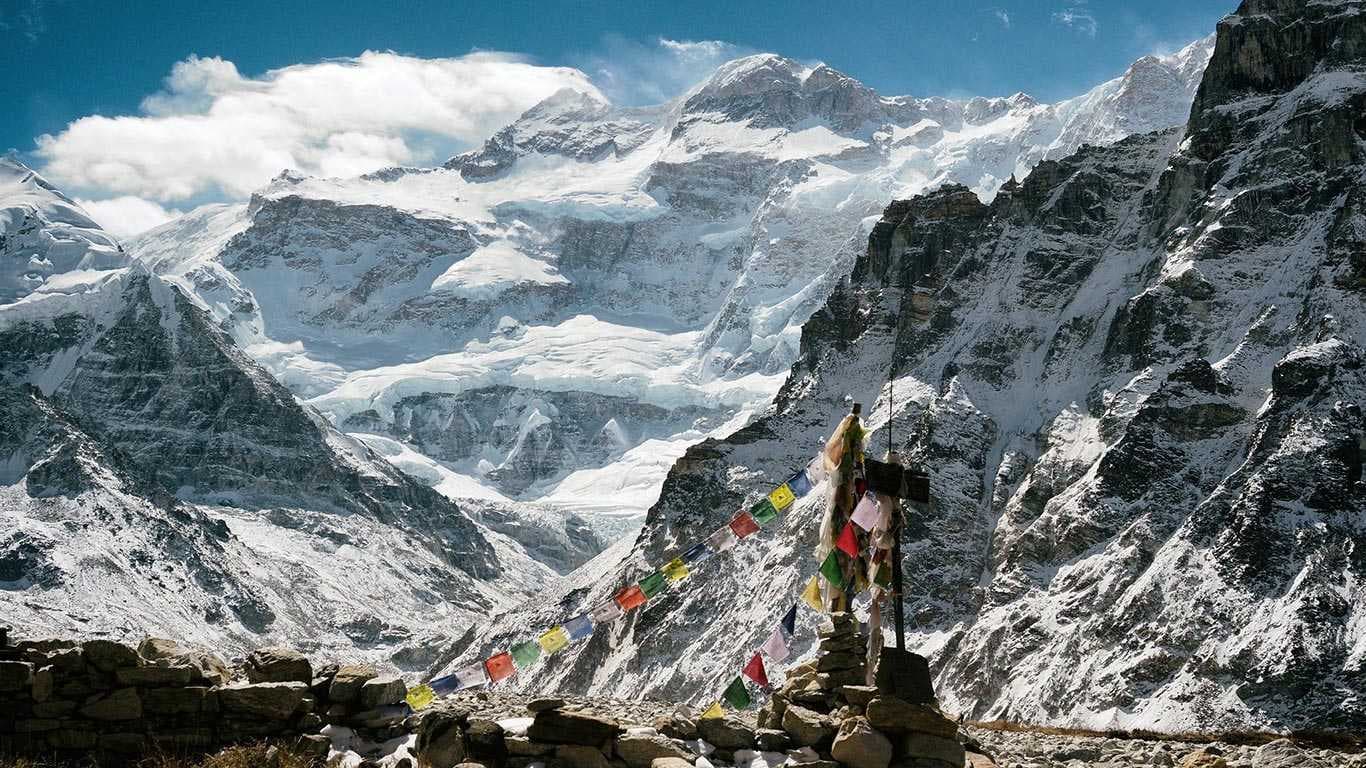
From the first Base Camp, we can see Mount Kanchenjunga in all its majestic glory. From the North Base Camp, locally known as Pangpema, we head to Ghunsa. The sights at Ghunsa are indeed a treasure to safeguard.
We then overcome the Nango La (4,820 m) and descend into the Yangma Valley and to Olangchunngola, a small hamlet known for yak farming.
We further ascend to a height of 5,160 m and ford the Lumba Sumba to reach Chyantang. Known for the Lhomi, an indigenous culture influenced by both Buddhist and Shaman traditions, we can experience a taste of what this sparse population practices.
From the town of Chyantang, we head on towards Mount Makalu having shared our journey so far with other trekkers from the Kanchenjunga Base Camp.
Our second leg of the journey culminates in conquering the Makalu Base Camp, following which we descend into the Barun Valley.
After a walk through the valley floor, we depart again at Shipton La Pass (4,125m) and Tumlingtar airstrip. From here, we catch our flight back to Kathmandu.
Best Season for Kanchenjunga & Makalu Base Camp Trek (GHT)
Most treks in Nepal have two best seasons to cover. The best seasons for Kanchenjunga & Makalu Base Camp Trek (GHT) are spring and autumn.
Unlike most treks in the popular destinations, the trip through the GHT holds a many challenges even in peak season. Travelers here have a small weather window. It is because of extreme isolation and high altitude passes.
Spring From March to May
Spring is a great choice for Kanchenjunga & Makalu Base Camp Trek. The winter snow melts away giving you a safe passage through the Lumba Sumba Pass.
Lower elevation welcomes trekkers with blooming nature. It’s during this time of the year, when you can she rhododendrons and wildflowers blossoming.
Autumn From September to November
Autumn is the best season for visual bliss in Nepal’s Himalayas. Trekking to the Kanchenjunga and Makalu Base Camp during fall is a great choice for photographers and cultural buffs.
As the post monsoon season, autumn offers a clean and crisp view of Kanchenjunga and Makalu. Moreover, the weather remains favorable throughout the journey,
Fall also welcomes multitude of big festivals in Nepal. Namely, Dashian and Tihar. Also, in November you can experience Futuk Festival in November at in Olangchu Gola.
Seasons To Avoid
Trekking during monsoon and winter should be avoided. They make the path needlessly dangerous.
During winter, Lumba Sumba and Nango Ka become impossible to cover. Additionally, the temperature can become unbearably cold, often going over -20°C+.
Monsoon bring heavy rainfall in Nepal. As such, the path become muddy, slippery, and full of leeches. Plus, the risk of landslides become a real threat.
Why Kanchenjunga & Makalu Base Camp Trek (GHT)
Kanchenjunga ‘The Five Great Treasure Houses of Snow’
Trekking around the third & fifth-highest peaks in the world
Isolation and the virgin trekking trials
Least trekking destination
Charming forests of pine, oak, rhododendron, and juniper
Why Choose Himalayan Trekkers?
We, Himalayan Trekkers, have trekking and expedition experience of over two decades. Our team are all seasoned guides, who provides you with deep and insightful information along the trail. Trekking with us ensures you a safe and fulfilling journey along the Himalayas.
We offers travelers custom itineraries and budget friendly packages. Himalayan Trekkers arranges comfortable accommodation according to your need and budget. We help you get the perfect treks and memories in the mountain in Eco-friendly way.
You Might Be Interested
Itinerary Detail
Departure Dates
What is Included / Not Included
- TIMS
- Permit & Entry Fees
- Airport Pick-up and Drop-off
- Transportation as per itinerary
- Accommodation as per the itinerary
- Guide, Driver, and Porter
- Meals (Breakfast, Lunch, and Dinner with Tea) during the trek
- First-Aid Kit
- Welcome/Farewell Dinner
- All taxes & surcharges
Accommodation
Himalayan Trekkers promises to manage the best, most comfortable and preferable accommodation. Generally, in cities like Kathmandu, we arrange basic three-star facilities. If available, you can opt for a more budget-friendly option or upgrade to a more luxurious hotel by paying a little extra.
During treks, all the places may not have modern facilities, we will make sure to arrange safe and comfortable accommodation. In general, hygienic and safe tea houses/local lodges/home-stays with all the basic facilities are arranged. But you can, if possible, personalize according to your preference.
If your itinerary includes camping or you choose to experience camping during your travel, a proper camping-site will be pre-decided. If required, we also provide the basic equipment which is refundable. Please check the Gear-List and Requirement List for more information.
Meals
Breakfast is usually included with your B&B Accommodation within the cost that is evident.
For other meals in the city, you would have to pay separately. Often in the cities, you can choose from many different cuisines and varied food services. We can always help you find the right place to fit your taste.
In more remote areas, usually, there are not many options. But you can always find hygienic and well-prepared food. Moreover, almost all the meals during the trek are included in the cost. We can help you make changes according to your preference and budget, but only if choices are available!
On top of that, Himalayan Trekkers also organizes Welcome/Farewell Dinner as a symbol of warm greetings.
Please go through the detailed itinerary for more information. We are always there to help you travel to your heart’s content.
Drinking Water
Drinking water is available in many forms during the trek. You can refill your water bottles in Teahouses for a cost. The other options is to filter and use Iodine tablets, UV light, or other methods.
The last option is to buy bottled water, however it isn’t a sustainable trekking to buy a bottled water in the Himalayas. The use and throw bottles pollutes the environment. As such, using a refillable water bottles helps both nature and people of the region.