

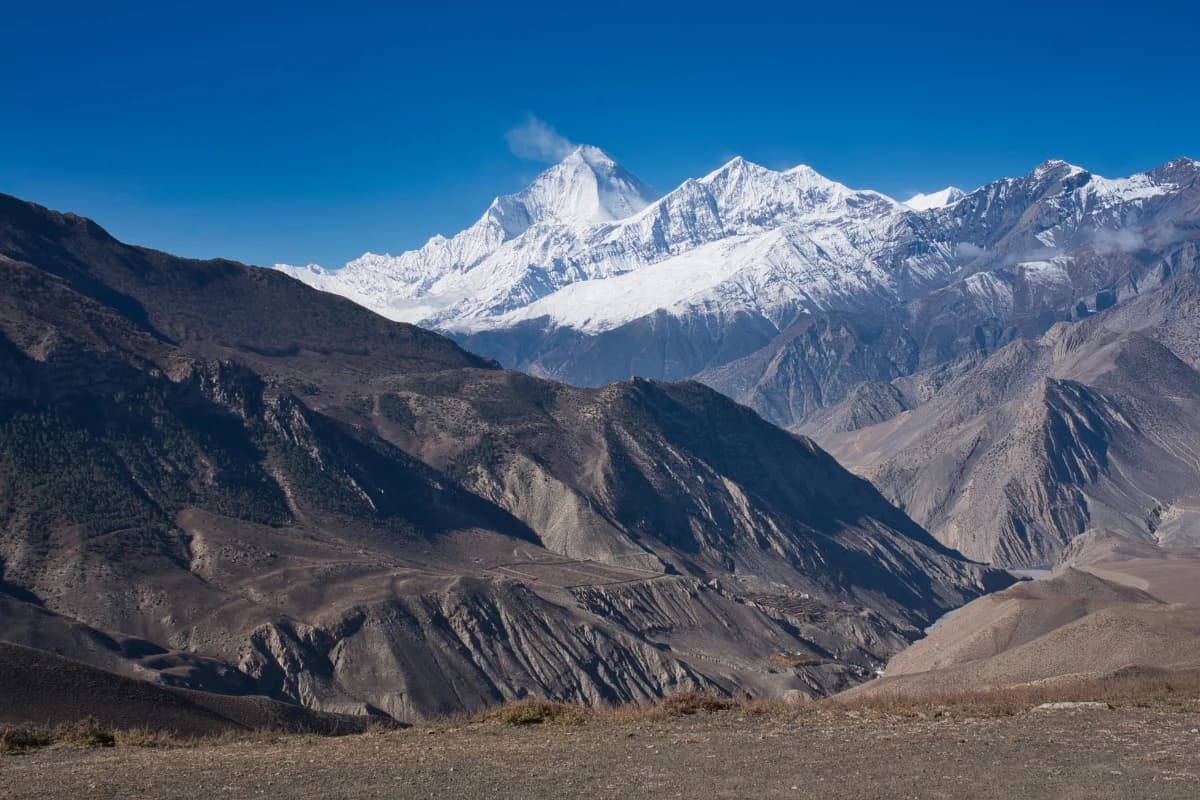
You stand on the Annapurna Circuit at 3,500 meters (11,482 feet). Mountains stretch infinitely everywhere. You take out your phone to remember the moment forever. One bar appears on your screen. Possibly. That's connectivity in the Himalayas.
Connectivity on the Annapurna Circuit Trek is possible. Just not in the same way as everywhere else. Everything about Wi-Fi, mobile network, and charging is completely different depending on where you are.
In lower-altitude villages, reliable 4G connectivity and affordable charging facilities are readily available. Further up, sending even a text is an effort in itself. Being aware of the situation beforehand prevents frustration, waste of money, and non-functioning devices.
Everything you need to know about connectivity on the Annapurna Circuit Trek, including mobile networks, Wi-Fi, internet prices, charging options, power banks, and solar charging.This guide answers all your questions on the topic.
Mobile Network Coverage on the Annapurna Circuit Trek
There are two major telecom providers in Nepal. These are Ncell and NTC (Nepal Telecom). There is no overlap in their areas of service. This is the key point regarding connectivity on the Annapurna Circuit Trek.
Taking one sim card is the most frequent mistake made by trekkers. Take both cards, if you can. Sim costs you NPR 200 to 300. It is less than your dinner at a tea-house. You will get the sense of taking two sims at Upper Pisang, when one of them shows you nothing while another shows two bars.

View of Manang Region during the Trek
NTC (Nepal Telecom) belongs to the government, and its coverage is deeper. NTC holds its signal longer while gaining altitude. Where Ncell has gone off, NTC still works. NTC is slower in urban areas, but starting from 3,500 meters (11,482 feet), it is totally worth each rupee.
Ncell is strong in Pokhara, Besisahar, Chame, and Jomsom. Ncell is fast in urban and lower altitudes. However, its connection starts fading in the region of Manang and disappears starting from 4,000 meters (13,123 feet).
Many guides and regular tourists of Nepal keep both the Ncell SIM card and NTC SIM card. These SIM cards can be purchased from NPR 90 to NPR 150, which is cheaper than a cup of coffee. One for the city areas and another for the mountains. This is the simplest way out for any trekkers travelling from Kathmandu to higher places.
Village by Village Mobile Network Coverage on the Annapurna Circuit Trek
This is a practical, straightforward step-by-step guide to mobile phone network coverage on the Annapurna Circuit Trek. Elevations are approximate.
Location | Elevation | NTC Network | Ncell Network | Connectivity Notes |
Besisahar | 760 m / 2,493 ft | Good | Good | Reliable network signal. Download maps, podcasts, music, and other content before heading higher. |
Jagat | 1,300 m / 4,265 ft | Good | Fair | The valley narrows here, and Ncell coverage becomes weaker. |
Dharapani | 1,860 m / 6,102 ft | Good | Fair | NTC provides reliable coverage. |
Chame | 2,710 m / 8,891 ft | 4G | Fair | One of the last reliable locations for data-heavy use before the high passes. Upload photos, make video calls, and download anything you need. |
Lower Pisang | 3,200 m / 10,499 ft | Fair | Poor | Ncell coverage is weaker, though it is better than in Upper Pisang. |
Upper Pisang | 3,310 m / 10,860 ft | Spotty | Poor | You may need to move around the village to find a signal |
Manang | 3,519 m / 11,545 ft | Moderate | Moderate | Connectivity is generally better in the early morning. This is the last major stop before the pass. |
Yak Kharka | 4,018 m / 13,182 ft | Poor | None | Connectivity is very limited. Do not rely on having a network connection here. |
Thorong Phedi | 4,525 m / 14,846 ft | Very poor | None | Connectivity is extremely limited. Inform family and friends beforehand that you may be unreachable. |
Thorong La Pass | 5,416 m / 17,769 ft | None | None | No reliable connectivity. This is the highest point of the trek. |
Muktinath | 3,760 m / 12,336 ft | Good | Good | Reliable connectivity resumes after crossing the pass. |
Jomsom | 2,720 m / 8,924 ft | Good | Good | A good stop to reconnect after the pass. |
Tatopani | 1,190 m / 3,904 ft | Excellent | Excellent | Strong connectivity, fast Wi-Fi, and hot springs are available. |
Besisahar, Chame and Jomsom are your three main connectivity anchors on the circuit. Make your important calls, uploads and downloads at these stops.
How to Get a SIM Card for the Annapurna Circuit Trek
Get your SIM card in Kathmandu or Pokhara before the trek starts. Not at the trailhead. Not in Besisahar.
Where to buy:
NTC and Ncell counters at Tribhuvan International Airport arrivals hall
Telecom shops throughout Thamel, Kathmandu
NTC and Ncell offices in Pokhara city center
What to bring:
Passport (original)
One passport-size photo
Activation takes under 10 minutes for foreign nationals
Typical data packages for 2026:
5GB for NPR 300, valid 30 days
10GB for NPR 500, valid 30 days
Combo packages with calls and data for emergencies
Recharge through cards or mobile applications is quite convenient. Use 1415# for NTC or 17123# for Ncell for checking or adding more data. Should there be a poor signal, the existing data will remain valid.
Those who use eSIM services can go for international services such as Airalo, Holafly, and Nomad providing Nepal data eSIM. The cost of a 5GB eSIM would be approximately 11 to 15 USD, while a 10GB plan costs 18 to 25 USD.
An eSIM service suits people who have an unlocked phone and wish to get connected immediately upon arrival. Keep in mind that eSIM service works on the basis of Ncell service only. Hence, it is not useful above Manang.
Satellite Communication Options for the Annapurna Circuit Trek
Satellite devices may be useful for those who need constant connectivity. The devices are not affordable. However, in case of emergency situations, they become a lifesaver.
Satellite messengers: Garmin inReach Mini 2 and Zoleo are examples of satellite devices that can help one send messages using satellites. These devices work in all areas of the Annapurna Circuit route, including Thorong La Pass. One-monthly plans begin with around USD 15. Hardware will cost USD 200-400.
Satellite phones: Iridium and Inmarsat satellite phones allow voice calls. However, they rent for high prices, about USD 50-100 per week and call charges. They are too expensive for most trekkers but useful for expedition leaders and filmmakers.
Personal locator beacons (PLBs): PLBs send emergency messages to the rescue authorities. They do not support two-way communication. They may be considered as a last resort device. An appropriate PLB costs USD 250-350.
How to choose? Satellite messengers are commonly carried by guides on guided trips. If one is an independent trekker, then the choice should also be a satellite messenger. It makes your relatives feel comfortable and enables one to get help in case of emergency situations.
Wi-Fi Availability and Cost on the Annapurna Circuit Trek
Wi-Fi at Teahouses on the Annapurna Circuit Trek is now easier to access than ever before. However, its availability can be rather erratic and frustrating.
Teahouses on the way generally provide basic Wi-Fi services. This is particularly true for teahouses located in low altitude villages like Besisahar, Jagat, Dharapani and Chame. The cost of Wi-Fi may vary, some will give you free access after having dinner.
Typical teahouse Wi-Fi costs:
Lower elevations: NPR 200 to 400 per device
Higher elevations: NPR 400 to 600 or more per device
Some teahouses offer free Wi-Fi with dinner
The costs become higher at an elevated altitude. This is in line with the general principle of the Annapurna Circuit Trek where with elevation, facilities become fewer while prices soar. Everything in the higher altitudes has to be transported through porterage or pack animals. The availability of fuel diminishes. Power generation using solar panels becomes less.

Type of plugs in Nepal
Internet facilities in teahouses are usually shared between everyone present there. If there are ten people who are uploading images at once, then the speed becomes very slow. Internet speeds typically range from 1 to 5 Mbps, depending on the location, network, and time of day. This allows for communication and web browsing but not video conferencing and streaming videos.
Wi-Fi access is increasingly restricted as you go up beyond Manang; however, Wi-Fi is accessible at some tea houses on the higher section. Wi-Fi access is possible at Yak Kharka and Thorong Phedi. It has been reported that Wi-Fi connection in some lodges functions well in terms of speed.
Availability of Wi-Fi varies from one teahouse to another. Moreover, Wi-Fi access may depend on the weather conditions, electricity availability, and number of users. Wi-Fi is relatively costly at higher altitudes.
A note of warning: The Wi-Fi services offered by teahouses are not secure. Do not use them for your banking transactions or any other private business.
Wi-Fi vs Mobile Data: Which Is Better on the Annapurna Circuit Trek?
The best option depends on your location and what you need to do:
Mobile Data | Wi-Fi |
Generally faster and more convenient in lower villages with good 4G coverage. | Useful where mobile coverage becomes limited or unavailable. |
Works without relying on a teahouse connection. | Availability varies between teahouses, especially at higher elevations. |
Best for regular messaging, browsing, and calls where the signal is strong. | Can be useful for larger downloads or communication when mobile data is weak. |
Requires a local SIM with sufficient data. | Usually requires a separate fee at teahouses. |
Charging Availability and Cost on the Annapurna Circuit Trek
Electricity on the Annapurna Circuit Trek is not always readily available. Electricity is a resource. As you go higher, there is less of the electric grid available. You go from wall plugs to solar-charging stations.
Lower Elevations (Below 2,500 meters / 8,202 feet)
Teahouses of the lower villages are mostly either connected to the electricity grid or have their own micro-hydro power plants. In fact, you can even find sockets in your personal room in the teahouse. Charging is either free or costs around NPR 100-200 per device or charging session.
Mid Elevations (2,500 to 3,500 meters / 8,202 to 11,482 feet)
The National Grid becomes unreliable. The majority of the teahouses have electricity from a combination of grid, solar, and mini-hydro power. The charging fee is NPR 200-400 per gadget. Power outages are frequent. Charging stations are available in the common dining hall, not in your room.
High Elevations (Above 3,500 meters / 11,482 feet)
Several villages use only solar energy. It implies that electricity depends on the weather. In case of cloudy days, it will be more important for the teahouse to light the dining room rather than charge your mobile phone. The cost of charging may be from NPR 400 to 700.

Thorong La Pass, the highest point of the Annapurna Circuit Trek
Typical charging costs in 2026:
Device Type | Lower Altitudes (NPR) | High Altitudes (NPR) | USD Equivalent |
Smartphone | 100 to 300 | 400 to 700 | $1 to $5 |
Power Bank (Large) | 300 to 500 | 600 to 1,000 | $3 to $8 |
Camera Battery | 200 to 400 | 500 to 800 | $2 to $6 |
Laptop / Drone | 500 to 800 | 1,000+ | $5 to $10+ |
Tea houses charge on a per device, per hour or per charge basis. Charging power banks at high-altitude locations such as Thorong Phedi can cost around NPR 300-500 per charging session.
Power Cuts and Charging Windows
Outages are inevitable on the Annapurna Circuit Trek. In villages that are grid-connected, power outages are common. Teahouses that run on solar power are low in their capacity to charge. The windows for charging last anywhere from 2 to 4 hours during the evening.
In cases where you are required to charge more than one gadget, be sure to charge your gadgets separately. It would be extremely impolite to remove someone else's device from the socket and connect yours.
Charging Points
However, most teahouses lack a charging point in their guest rooms. You will get it in the communal dining hall or the reception area. Thus, you cannot leave your phone to be charged overnight in your room. You can only charge during meal times.
Bring a universal charger. Nepal uses Types C, D and M sockets. The voltage is 220V to 240V. You will require a voltage converter if your gadgets run on 110V.
Power Banks and Solar Chargers for the Annapurna Circuit Trek
Should you wish to save money and stay independent, bring your own source of energy. It is not an option. It is mandatory.
The Power Bank Strategy
Carry a high-capacity power bank. Minimum 20,000mAh. This will be able to charge a modern smartphone 4 to 6 times. Best choices would be the Nitecore NB20000 and Anker PowerCore. They are relatively light-weight and cope well with cold better than low-cost models.
At night, keep your power bank and your smartphone in your sleeping bag next to your body. Your body heat stops the batteries from discharging at sub-zero temperatures. The cold reduces battery life 30 to 50 percent faster compared to the same altitude at sea level.
The Solar Charger Strategy
For hikes lasting more than 12 days, a solar panel is the way forward. A portable solar panel of 21W or 28W capacity will be ideal for your use.
Your phone should not be plugged into the panel. High voltage will damage your phone. Instead, you should use your solar panel to charge your power bank. From the power bank, you charge your phone. It is a bit slower, but your phone will be safe.
The solar charging process is most effective on sunny days, especially in high altitudes. The Himalayas are extremely sunny. Cloud cover, shade, and low temperature affect the efficiency of the process. It is not wise to depend on solar only.
How Many Power Banks Should You Bring?
It takes just one power bank of 20,000 mAh for a 12 to 15 days trip when you charge it from time to time at the tea houses. If you have a camera, drone or any electronic gadget, carry two of them. It is heavy, but dead gadgets are even heavier than a bag.
Power Bank Safety Tips for the Annapurna Circuit Trek
The power bank is safe provided that it is used properly. Cold weather, altitude, and mishandling may lead to complications. Here are some recommendations for safe usage.
Never overcharge. Make sure to unplug your power bank when it reaches maximum capacity. Overcharging might damage your power bank and even cause overheating.
Avoid heat. Do not expose your power bank to direct sunlight or to the heat source like the stove. Heat destroys the battery.
Watch out for swelling. If your power bank is swollen or warm, never use it because it will become very hazardous.
Use original charging cables. Cheaper cables might cause a short circuit. Take some extra charging cables from the brand you use.
Do not check power banks. There are special requirements concerning transportation of lithium batteries on board airplanes. It concerns all flights to/from Lukla and Jomsom.
Keep power banks dry. Moisture may damage electronics. Store power banks in a waterproof stuff sack or in a zip-lock bag.
Charging one device at a time. Charging several devices at a time causes your power bank to drain faster and produces more heat.
Areas With Limited Connectivity on the Annapurna Circuit Trek
Connectivity becomes more limited as you approach the high-altitude section of the Annapurna Circuit. The main areas to be prepared for are:
Thorong La Pass (5,416 m / 17,769 feet): There is no coverage in terms of cellular service here. This is the highest point of the trek.
Thorong Phedi (4,525 m / 14,846 feet): Cellular coverage is very limited here, therefore, do not expect to make any calls or to have internet access.
Yak Kharka (4,018 m / 13,182 feet): Cellular coverage is limited and unpredictable.
Upper Pisang (3,310 m / 10,860 feet): Cellular coverage can be sporadic and you will need to move around the village in order to get a better signal.
Manang to Muktinath: This high altitude section has the most limited and erratic connectivity of the entire circuit.
Tips for Staying Connected and Keeping Devices Charged on the Annapurna Circuit Trek
These are some practical recommendations for keeping your communication channels open and ensuring that your devices are powered while hiking the Annapurna Circuit Trek.
Buy SIM cards from both companies. NTC and Ncell together will cost you less than NPR 500. The duplication will pay off.
Install maps in offline mode. Google Maps, Maps.me and Organic Maps provide this possibility. Do it either in Kathmandu or Pokhara. Do not install them after arriving in Besisahar.
Inform your relatives about your schedule. Let them know about your hiking schedule and communication issues. Also, tell them that you will be out of communication for two to three days near Thorong La Pass.
Take a 20,000 mAh power bank. 20,000 mAh is enough for the majority of hikers. Take two in case you use cameras or drones.
Consider taking a solar charger. A foldable 21W charger is a great addition in case of long treks. Use it to charge your power bank, but not your smartphone.
Keep your gadgets warm during the night. Place your phone and power bank inside your sleeping bag. The cold drains your batteries.
Avoid using background apps and automatic updates. Save power and data by not enabling automatic updates, cloud backup, and push notifications.
Go on airplane mode when you don’t need internet connectivity. Airplane mode helps save considerable battery power.
Charge your gadgets during meals. The teahouses provide charging points in the evenings. Use mealtime to recharge your gadgets.
Get a universal plug. Nepal uses Type C, Type D, and Type M sockets. Voltage is 220V to 240V.
Final Thoughts on Staying Connected on the Annapurna Circuit Trek
The Annapurna Circuit Trek is not a digital detox by design. It is a digital detox by geography. The mountains do not care about your Instagram feed. They care about whether you brought enough power to keep your headlamp working.
Staying connected on the Annapurna Circuit Trek requires preparation. Buy both SIM cards. Download offline maps. Bring a power bank. Keep your devices warm. Tell your family when you will be offline. And accept that some days, the only connection you will have is with the mountains themselves.
Take advantage of the good internet connection when available in such locations as Chame, Muktinath, and Jomsom and make those crucial calls and upload and download necessary material for the subsequent part of the trek.
Plan Your Annapurna Circuit Trek With Us
Do you plan an Annapurna Circuit Trek in 2026? Write us a message on WhatsApp at +977-9851042334, and we will be happy to help you organize your trek according to your schedule, preferences, and physical condition.